Eshu
Èṣù, in Yoruba
a little scary
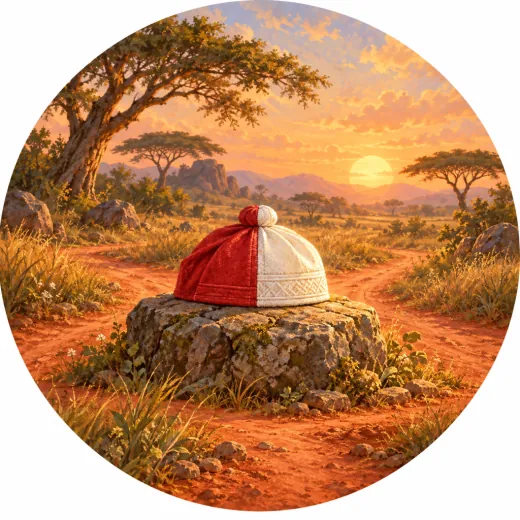
Eshu is the orisha of crossroads and the messenger between humans and the other orishas: every prayer and every offering passes through him. He is unpredictable and loves to test people. A very famous tale says that he walked between two inseparable friends who worked in neighbouring fields, wearing a hat that was red on one side and white on the other. Afterwards the two quarrelled furiously: one swore the hat was red, the other that it was white. The story teaches that each person sees only one part of the truth.
Did you know? He is often the first orisha to receive an offering during ceremonies, because without him messages do not get through.
The story
There are places where roads meet, and every place like that has a master.
His name is Eshu. If you pass a crossroads and hear, for no reason, a rustle in the grass, or a whistle that seems to come from two directions at once, you have been noticed. There is nothing wrong with that. Eshu notices everyone. He knows who is going to market, who is coming back from a funeral, who has a prayer they do not dare say out loud. Because every prayer, to reach the orisha, has to pass through him. He is the messenger. He is the door. And that is why every ceremony begins with a small offering for Eshu: if you do not greet the doorkeeper, no message ever arrives.
But Eshu has a flaw. Or a virtue, depending on who is telling the story. He cannot stand things being too peaceful.
Once upon a time there were two friends. They had known each other since they first learned to walk, and now they were grown men, each with a wife and children. They had two fields, side by side, divided only by a path of beaten earth. They worked together from morning till night, and in the evening they shared the same bowl. They told everyone: “We never argue. We are like two fingers of the same hand.”
One day Eshu heard them, as he sat on a stone at a crossroads nearby.
“Never?” he said to himself. “We’ll see.”
He stood up, brushed the dust off his clothes and put on a hat. It was a strange hat. On one side it was red as a chilli pepper, on the other white as flour. Eshu pulled it down firmly over his forehead, picked up a stick and set off, whistling.
He reached the path between the two fields at the hour when the sun is highest and the earth burns under your feet. The two friends were each in their own field, bent over their hoes. Eshu began to walk along the path, calmly, like someone in no hurry at all. From one side of the path you could see his face and the red side of the hat. From the other, you could see his back and the white side.
He walked slowly past the two fields. He waved. There was no one else on the path: no witness, no shadow, only the buzzing of the cicadas and the smell of scorched earth. It was the perfect hour for a trick, and he knew it.
The first friend looked up. “Good day!” he called. He saw a man walking away in a red hat, and went back to his hoeing.
The second friend looked up. “Good day!” he called. He saw a man walking away in a white hat, and went back to his hoeing.
Eshu carried on along the path without turning round. Behind him, in the silence of the fields, there was only the sound of hoes biting into the earth. A calm, orderly sound. Exactly the kind Eshu could not stand.
Evening came. The two friends met on the path, as they did every day, to walk home together.
“Did you see that man?” said the first. “The one with the fine red hat?”
“Red?” said the other. “That hat was white.”
“Red. Like a rooster’s blood.”
“White. Like milk.”
They looked at each other. They had never argued before, and so they did not know how to stop. The first said the other must have had the sun in his eyes. Then, that he had always boasted a bit about his harvest. Then, that he had never really cared for him. The other said the first had an empty head. The first brought up a nasty business about a loan never paid back, ten years old, which he had never told anyone about. The other answered with a story about a goat. Their voices rose and rose. The hoes fell to the ground. Someone far away heard the shouting and understood that something had broken, without being able to say why.
Behind a bush, Eshu was laughing with his whole throat, without making a sound.
In the end the two could no longer speak to each other. They went to the village chief, an old man with a white beard and a long patience, and each told him his side of the story, chest puffed out and voice shaking.
“Red,” said one.
“White,” said the other.
The elder listened to it all without interrupting. Then he looked out of the door and said quietly, “It seems to me that someone is missing here.”
At that very moment a man appeared in the doorway, as if he had heard everything. It was Eshu. He walked in calmly, his stick on his shoulder, and on his head he wore the hat.
“Good day,” he said. “Were you looking for me?”
The two friends stared at the hat. Then they stared at each other. Eshu took off the hat and turned it slowly in his hands, once, twice: red, white, red, white.
“You are both right,” he said. “The hat is red. The hat is white. Each of you really saw what you saw. But neither of you thought there might be another side.”
No one spoke. Outside, a rooster crowed by mistake, at that hour.
“And why did you do it?” asked the elder.
Eshu smiled, and for a moment, in the low light of the room, his face seemed to change, as if he too had two sides.
“Because I like to see what is left of a friendship when you give it a little shake,” he said. “And look: it is still standing. A bit dented, but standing.”
The elder did not laugh. But he did not get angry either. He knew that you do not argue with Eshu: you learn, or you pretend to learn.
The two friends went home that evening, each by a different road, and it took them a while to speak to each other again. But when they did, the first question was: “What did you see?” And, for the first time, they listened to the answer.
Ever since, in that village, when two people argue over something they have seen, someone always asks: “But which side were you on?” And before every prayer, before every festival, an offering is left at the crossroads. Not out of fear. Out of good manners.
Because Eshu is always there, at the end of every road. And if you greet him first, at least you will be spared a trick.
A living tradition, told with respect: how we tell myths.
Relatives around the world
Listen / Read next
- Music to read by: Cinematic JourneyEpic film-style music, no lyrics, by Ciro Simone IrmiciSpotifyYouTube Music
Sources
- Wande Abimbola, Ifá: An Exposition of Ifá Literary Corpus (1976)
- Ayodele Ogundipe, Esu Elegbara, the Yoruba God of Chance and Uncertainty (1978)
