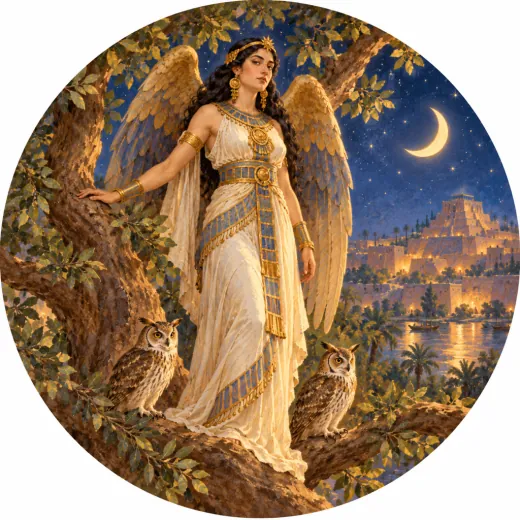
Lilith
lilītu, in Akkadian
scary
Lilith is a figure who may have her roots in Mesopotamia and who changed a great deal over the centuries. In the ancient Sumerian and Babylonian spells of protection we find the lilītu, spirits of the wind and the night. In a Sumerian poem a similar creature hides among the branches of the goddess Inanna's tree, until the hero Gilgamesh drives it away: the poem does not call it Lilith, and scholars debate whether it is the same figure. Much later, in medieval Jewish legends, Lilith becomes Adam's first wife, who refuses to obey him and flies away. To protect homes from night spirits, people used amulets and bowls with written spells.
Did you know? A famous Babylonian relief in the British Museum, the “Queen of the Night”, used to be called “of Lilith”; today scholars think it more likely shows a goddess.
The story
In a dark room there is a cradle, and beside the cradle a mother who is not asleep.
Perhaps it is an old house in Babylon, perhaps a village in the Middle Ages. Outside it is the dead of night. The baby is only a few days old. The mother has done everything that ought to be done: under the bed she has put a clay bowl with writing in a spiral, words and the names of angels, and on the door she has fixed a slip of paper with more names. They told her it works.
It works against her.
Every so often the wind bangs a shutter. The mother holds her breath, then lets it go. The baby breathes softly, one hand curled into a fist beside his cheek. In that house, sleeping is a job for two: one sleeps and the other keeps watch.
Lilith. A name many people know, and almost nobody knows where it comes from.
The truth is that there is not just one Lilith. There are many, grown one on top of another like the layers of an ancient city.
Let's start at the bottom.
In the cities of Mesopotamia, about four thousand years ago, incantations spoke of spirits called lilītu: beings of the wind and the night, who prowled around houses after dark. They had no face. They were more like a breath, a sound, that feeling of being watched in the dark. On clay tablets, scribes wrote down the spells to send them away.
Then there is a Sumerian poem, very ancient, that tells of a tree.
It was a willow, growing on the bank of the Euphrates. The goddess Inanna had replanted it in her garden, because she wanted to make herself a throne and a bed from its wood. But by the time the tree was fully grown, someone had already moved in. At its roots, a serpent that no spell could tame. At its top, the Anzu bird with its young. And in the middle of the trunk, a creature the poem calls “ki-sikil-lil-la-ke”, which we might translate as “the maiden of the wind”, who had built her home there.
Inanna wept. Then Gilgamesh came, with his bronze axe. He killed the serpent. The bird fled to the mountains. And the creature in the trunk smashed her home and fled into the wilderness.
Some scholars think that maiden is the first Lilith. Others are not sure: in the poem her name is a different one. We cannot know.
Centuries pass, empires pass.
In the Hebrew Bible her name appears only once, in a verse by the prophet Isaiah. It describes a ruined, abandoned land where only wild animals live: the jackal, the owl, the wild goat. And among them is the “lilit”, who finds a place to rest there. Even today nobody is quite sure how to translate it: an owl? A night creature? One word, and nothing more. No tale, no story.
Then comes the Talmud. It barely mentions her. It says that Lilith has long hair, and that it is dangerous to sleep alone in a house.
At around the same time, between the fifth and seventh centuries AD, ordinary people in Mesopotamia wrote spiral incantations inside clay bowls and buried them upside down under the floors of their houses. Some of the bowls name Lilith. A few order her to leave using the wording of a bill of divorce, the way you would deal with a guest you no longer want: nobody was ever to trouble that house again.
And then, at last, the story.
It is told in a medieval book, written perhaps between the eighth and tenth centuries, called The Alphabet of Ben Sira. It is not the Bible. It is a popular text, full of anecdotes and questions, written by someone who wondered what everybody wonders: what was the world like before Eve?
The book answers like this.
When God created Adam, he also created a woman, and he made her from the same earth, in the same way. Her name was Lilith. They lived together, but they soon began to quarrel.
“I will not lie beneath you,” she said.
“It's you who must lie beneath me,” Adam replied. “I am the superior one.”
“We are equal,” said Lilith. “We are made of the same earth.”
Neither would give way. So Lilith did what the book tells in just a few words: she spoke the Name of God, the name nobody must say, rose into the air and flew away.
Adam, left alone, complained to God.
God sent three angels to bring her back: Senoy, Sansenoy and Semangelof. They found her in the middle of the sea, in a place where the waves beat against the desert. They said to her: “Go back to Adam. If you do not, a hundred of your children will die every day.”
Lilith did not go back.
“I was made to harm newborn babies,” she said. “That is what I was born for. For eight days for the boys, for twenty for the girls, I will always be at their door.”
But the angels made her swear one thing. If she saw their names, or those of their companions, written on an amulet, she would not go in. And Lilith swore.
That is why, the book says, the names of the angels are still hung over the beds of newborn babies.
That is the story. And here something must be said that the story itself does not say.
Whoever wrote it, in the Middle Ages, wanted to explain why little babies fell ill, why some nights were full of fear. So he took a very old figure made of wind and gave her a face, a name, a reason. A guilt. But in doing so, he had to put in her mouth a sentence that people have argued about for centuries: “We are equal.”
The Lilith of the story is not, deep down, a demon from a film. She is a word left without a home, which everyone, for a thousand years, has filled with their own fears.
The mother in the dark room does not know this. She looks at the cradle. She looks at the bowl under the bed. Outside, there is the wind.
And in the wind, for one more night, there is something that has a name, and does not come in.
Relatives around the world
Listen / Read next
- Music to read by: Cinematic JourneyEpic film-style music, no lyrics, by Ciro Simone IrmiciSpotifyYouTube Music
Sources
- Gilgamesh, Enkidu and the Netherworld, Sumerian poem
- The Alphabet of Ben Sira (Middle Ages)
- British Museum, The Queen of the Night relief
