The Kingdom of the Fanes
“Rëgn de Fanes”, in Ladin
a little scary
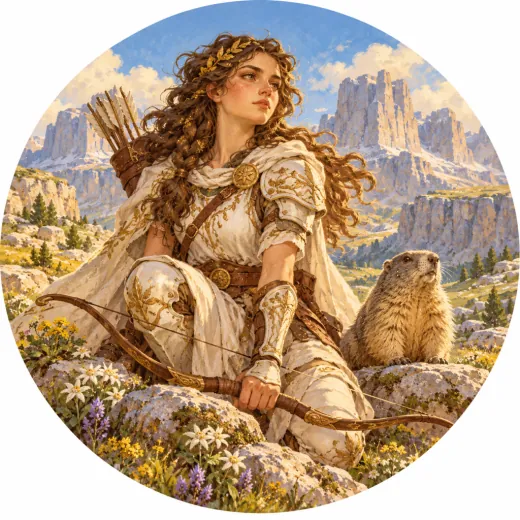
This is the great saga of the Ladin people of the Dolomites. On the Fanes plateau lived a people allied with the marmots, until the foreign king the queen had married changed the kingdom's emblem, removing the marmot and putting an eagle in its place. That betrayal was the beginning of the end. The saga features the warrior princess Dolasilla, with white armour and arrows that never miss, an evil wizard and a hero called Ey de Net. In the end the few surviving Fanes took refuge inside the mountain, where they are still waiting for the sound of the silver trumpets.
Did you know? The saga was collected and partly stitched together by the writer Karl Felix Wolff, who joined fragmentary, scattered oral material.
The story
On the Fanes plateau, before men learned to write, there lived a people who frightened nobody.
They were gentle folk. They grazed their flocks, hunted little, and had made an alliance with the marmots, the small mistresses of the high meadows. Every morning, when the sun touched the peaks and the meadows filled with light, the marmots came out of their burrows and whistled to the Fanes, and the Fanes answered. On their coat of arms was a marmot. It was a small, round emblem, without claws, and it suited everyone.
Then the queen married a king who came from far away.
He was a greedy and warlike man, and his first act was to change the coat of arms. He took away the marmot and put an eagle, with wings spread and talons open. "A kingdom that wants to grow," he said, "cannot have for its symbol an animal that hides underground."
The marmots, that day, did not come out of their burrows.
The old people of the kingdom noticed, and for a while said nothing. Then they began to say it in a low voice, in the evening, by the fire: since the eagle came, the meadow is quieter. The kingdom was stronger, that was true. But it was also harder, and more suspicious, and people had stopped singing as they worked.
The king had a daughter, and called her Dolasilla. From the dwarfs, the small smiths of the mountains, the girl received two gifts. A white armour, that no blade could pierce, and some arrows that never missed their target. The girl took them with respect, without asking for more. Dwarfs give nothing for free, she thought, and she was right. With those in her hands, Dolasilla led the army of the Fanes from one victory to the next. The kingdom grew, valley after valley. Nobody could stop her.
But the dwarfs had also said another thing. Dolasilla's invincibility would last only as long as she did not marry.
One day, in battle, Dolasilla met an enemy warrior called Ey de Net, "eye of the night". It was not the first time they had seen each other: they had met years before, and neither had forgotten. They looked at each other for a long time, in the midst of smoke and iron, and understood everything before speaking.
"I no longer want to fight against you," she said.
"Nor I."
They decided to marry.
When the king found out, he flew into a rage. He opposed it harshly, and did what nobody expected: he sent Dolasilla and all his people to destruction, knowing now that the kingdom was about to end.
On the eve of the last battle, the wind was cold. Dolasilla polished her armour and counted her arrows, one by one, in the silence of the camp. She saw nobody approach. But in the dark, among the tents, someone was crawling.
He was called Spina de Mul, and he was a sorcerer. Some say he looked like a half-rotted mule skeleton, with dangling bones and two empty eyes. By trickery, while Dolasilla slept, he stole her arrows.
At dawn, when the girl put on the armour, she saw it darken. The white turned grey, then black, and she felt inside her that her time was over.
She fought all the same.
The enemies, at first, looked for the white armour everyone spoke of, and did not find it. Then they understood. And then a rain of arrows, her own arrows, the ones that never missed, fell on her. Dolasilla died under the blows of her own weapons.
The king, that day, betrayed everything and everyone. They say he ended up turned to stone: a hard, cold rock, which since then looks at the valley without seeing it. Some say he is still there, on the Falzarego pass, and that the name of the pass means just this: falza rego, the false king. It is a folk etymology, but it tells the story well.
The few Fanes who remained, with the queen and the marmots, vanished into the rock. They went down into a deep cave beneath the mountains of their kingdom, and the stones closed behind them.
They are still there, they say. They sleep with the marmots, in the warm darkness of the mountain, and wait for the sound of the silver trumpets that will announce the rebirth. They are waiting for the signal.
On the plateau, now, there is silence. In summer walkers arrive in heavy boots, and the wind carries away their talk. And yet someone swears that early in the morning, when the sun touches the peaks, somewhere in the meadow a marmot whistles three times, loudly, towards the mountain.
Then it waits, head held high, for an answer that does not come.
Not yet.
The saga of the Fanes, for a long time, was written by nobody. It passed from mouth to mouth, among the Ladin valleys of the Dolomites, in pieces, like the stones of a landslide. It was Karl Felix Wolff who gathered it and stitched it together, in the first decades of the twentieth century, with stitches in the places the old people no longer remembered. That is why each teller tells it a little differently. But its hardest pieces always stay the same: the marmots, the eagle, the girl with the white armour, and a whole people sleeping beneath the rock, waiting.
Listen / Read next
- Music to read by: Cinematic JourneyEpic film-style music, no lyrics, by Ciro Simone IrmiciSpotifyYouTube Music
Sources
- Karl Felix Wolff, «Dolomitensagen» (1913) e «Il regno dei Fanes» (1932)
- Associazione turistica Alta Badia, «Miti e leggende ladine»
