The Brownie
brownie, in Scots
not scary at all
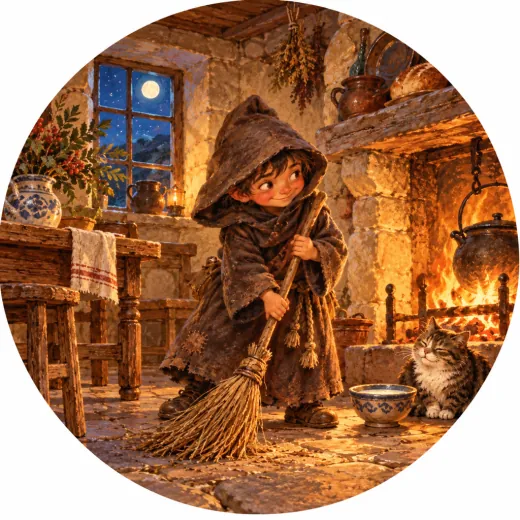
The brownie is a small, hairy, dark little man who picks a Scottish farm and lives there in secret. At night, while everyone is asleep, he works: he sweeps, grinds the grain, tidies the cowshed and finishes the chores left half done. In return he wants only a bowl of milk or cream and a piece of bannock left near the fireplace. But be careful: if you give him new clothes, or try to pay him, he takes offence and leaves forever.
Did you know? The youngest Girl Guides in Britain are still called “Brownies”, because they help around the house just like him.
The story
The farm stood at the bottom of a valley, beside a burn, and for years nobody could work out how it kept going.
The farmer wasn't lazy, but he wasn't especially strong either. His wife worked from dawn till night, and the children were still small. And yet every morning the barn was in order. The corn that had still been in sheaves the evening before was already threshed, and the flour was already in its sacks. The sheep, which the day before had been scattered all over the hill, were all in the fold, counted. In the kitchen the floor was swept and the embers were banked with ash, just as they should be.
At first the family eyed one another with suspicion. Then, one evening, the farmer decided to stay awake.
He hid behind the byre door with an unlit candle in his hand, and waited. When the house had gone quiet there came a rustling, like a very large mouse in a very good mood. Out of the corner by the fireplace came a little man.
He was about as tall as a six-year-old child, dark all over, hairy as a small bear, with a wrinkled face and clothes that were nothing but a great many tatters. He walked barefoot and hummed to himself. He took the broom, which was taller than he was, and began to sweep with tremendous seriousness. Then he went to see to the byre, and after that to the barn, to thresh the corn with a flail bigger than his own arms.
The farmer watched him for an hour, open-mouthed. In the end he couldn't help himself, and said, under his breath:
“Thank you.”
The little man froze. He turned slowly and stared at him, his lip trembling.
“You don't say that,” he hissed.
“What?”
“Thank you. You don't say it. Ever. It's rude.”
And he vanished.
The next day the corn wasn't threshed. The day after that, the milk had gone sour, the cellar door was open and the hens were on the roof. On the third morning the farmer found a great knot in the tail of the gentlest cow, who stood looking at him with a guilty air.
It was his wife who understood. That evening she set out a bowl of cream and an oatcake still warm from the griddle, and put them on the edge of the hearth without saying a word. In the morning the bowl was empty, and the floor was swept.
“There,” she said. “That's enough. No talking. You leave out something to eat and pretend nothing's happening.”
From that day on the farm began to prosper. The family learned the rules, and the children repeated them like a nursery rhyme: cream every evening, an oatcake every evening, nobody watching him at work and, in that house above all, no thank-yous. The farmer, who liked the sound of his own voice, sometimes had to bite his lip.
Many seasons went by. The children grew up, and little by little they stopped thinking of the brownie as a person. He had become part of the house, like the stove or the roof.
One day a cousin of the wife's came to visit. She came from the city and wore a hat with a feather in it. She spent the night in the children's room and, in the dead of night, she was woken by a noise. She peeped round the door and saw the little man, broom in hand, stopping to scratch his back against the chimney.
In the morning, at breakfast, she put her hands to her cheeks.
“How sad,” she said to her cousin. “Poor little thing. Wearing those rags, he must be frozen in winter. How can you leave him like that? He's worked for you for years and you won't even give him a shirt!”
“He doesn't want anything,” said the wife.
“Everyone wants something. Take it from me: it's a matter of having a good heart.”
The wife thought it over. She really did have a good heart. That evening, after her husband had fallen asleep, she took a piece of dark wool and quietly sewed a little hooded cloak. She folded it carefully and left it on the edge of the hearth, next to the bowl of cream, and went to bed with a satisfied smile.
At midnight there was a rustling. Then a silence. Then a held breath.
From the bedroom they heard a tiny voice, repeating softly, almost to itself, the way you repeat a poem you learned as a child:
“Give the brownie a cloak, give the brownie a shirt, and you'll have no more of his work.”
The farmer woke with a start.
“What's that?”
“Nothing,” said his wife. But her heart was pounding. She knew she had made a mistake.
They both peered round the kitchen door. The little man stood in the middle of the room, the cloak on his shoulders and the hood on his head. He was looking at himself in the bucket of water. The cloak suited him beautifully: he had the face of someone who, for the first time in his life, sees that he is handsome.
He looked up and saw the two of them, in their nightclothes, with the lamp in their hands.
“It's beautiful,” he said in a broken voice. “Nobody ever gave me anything before. But a well-dressed brownie doesn't work any more. Everybody knows that.”
“Stay,” said the wife. “Please. We'll tear the cloak up ourselves, if you like...”
The little man smiled, and it was the saddest thing they had ever seen. He shook his head. He straightened his hood. He opened the door, went out into the dark, and closed it gently behind him.
The next morning the corn was still in sheaves, the cows were still waiting to be milked and the floor was covered in dust.
For a long time the wife stood there with the broom in her hand. Then she leaned it against the wall, took a bucket and a cloth, and began to scrub the floor with an anger that surprised even her. The farmer watched her for a while. Then he went to thresh the corn.
On winter evenings, when the wind comes rushing down along the burn, some people say they have seen a small dark figure in a new cloak at a farm on the other side of the valley. They say that over there, the cream never runs out.
Relatives around the world
In the trails
Listen / Read next
- Music to read by: Cinematic JourneyEpic film-style music, no lyrics, by Ciro Simone IrmiciSpotifyYouTube Music
Sources
- Walter Scott, Minstrelsy of the Scottish Border (1802–1803)
- Katharine Briggs, A Dictionary of Fairies (1976)
