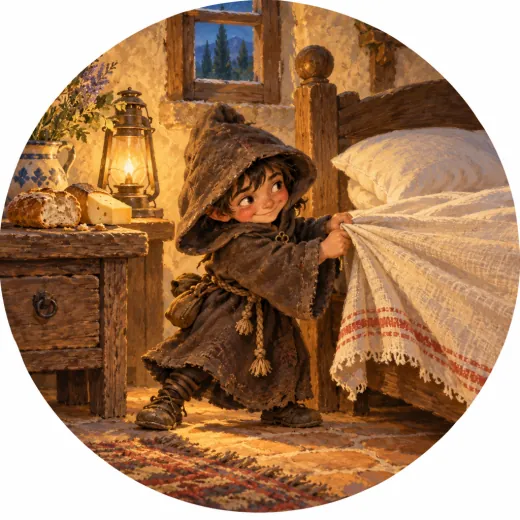
The Linchetto
the elf of the Lucca area
not scary at all
The Linchetto is the house elf of the province of Lucca. He is not bad, but at night he cannot keep still: he pulls the blankets off sleepers, knocks on doors, moves things around and makes strange noises in the kitchen. In the stables he enjoys tying the tails of cows and horses together. His looks change from story to story: sometimes a tiny little man, sometimes an odd little animal. To keep him away, people hung a sprig of juniper behind the door: he stops to count its leaves.
Did you know? One trick to keep him busy was to leave a cup of rice on the bedside table: the Linchetto cannot resist, tips it over and starts counting the grains.
The story
In a country house, on the hills above Lucca, lived a family who never slept peacefully at night.
By day the house was a house like any other. There were the kitchen with the fireplace, the room where the chestnuts were dried, the stable with two cows and a horse, and a child who ran everywhere. At night, instead, things happened.
It began with a knock.
Knock. Knock. Knock.
Someone was knocking at the door of the house, at midnight, softly, with patience. The grandfather, who was a light sleeper, opened. Outside there was darkness, a little fog, and the dog raising its head without barking. Nobody.
"He is back," said the grandfather, closing the door again.
And everyone in the house knew who.
It was the Linchetto, the mischievous house elf of the Lucca hills.
Nobody had ever seen him properly. According to the aunt he was an animal: a dog, or a cat, or a bird. According to a neighbour he was a little mouse, a little bird and a little man, all at once, which even made you laugh to think of it. According to the child he was invisible, and anyone who said otherwise was telling tall tales. One thing, however, was sure: he was not wicked. He was mischievous. And there are pranks that, when they happen to you at three in the morning, seem like the end of the world.
That night it began in the kitchen.
From the pantry came a noise of things being moved. When the grandmother lit the candle, the ladle was no longer in its place, the salt was on the windowsill and the fork had vanished.
"Ah, well done," said the grandmother in Tuscan, loudly, to the ceiling. "Well done. Enjoy yourself."
Nobody answered. But a crumb fell on the table, as if to say they had heard.
With children, it was said, the Linchetto was affectionate, so much so that the little one had never been afraid of him. With elderly women, instead, he had no scruples: he targeted them more than anyone. And in that house the oldest woman was the grandmother.
So, when the grandmother went back to sleep, the blankets flew away. She took them back. They flew again. She took them back, grumbling, and gripped them with both hands.
The child, in the next bed, was laughing with his face in the pillow.
"Do not laugh," said the grandmother.
But he laughed again, and perhaps that was why it was his turn too. Around three, the child woke up with the feeling of a light paw on his chest. It did not hurt: it was a weight, a short breath. He thought he could not get air, and from his throat came a phrase he had heard a hundred times from the old people of the village.
"Oh God... the Linchetto is taking me."
And at that moment he heard, from the bed, the stifled laugh of his grandfather.
"Yes, he has taken you," he said. "Now leave him be."
The weight vanished as it had come. Only the window remained, banging softly.
The next day, in the stable, they found the worst.
The tails of the two cows were tied together with a tight knot. And the horse's mane, which had always been smooth and shiny, was reduced to a long plait full of knots.
The cows, moreover, were tired as after a day's work. They had spent the night kicking at nothing, and now they lowed softly, offended, with big eyes.
"Do not undo it," the grandfather said at once, seriously. "If you undo it, the animal is worth nothing. Leave it as it is."
The child looked at the plait with respect. It was almost beautiful. Whoever had made it, he thought, had the hands of an artist, or paws, or whatever they were.
In the evening, the grandmother decided that was enough.
She took a blessed candle and lit it on the table. The light flickered, and for a while no noise came from the kitchen. She hung a sprig of juniper behind the door, because she knew that the Linchetto, finding it, would have to count all the leaves, one by one, and would not be able to stop.
And then, a last trick, she put a cup full of rice on the bedside table.
"Now we shall see," she said.
She turned off the lights and lay down with all the others.
For a while, the house stayed still. The fire dozed. The cat purred. Then, in the dark, a thin noise was heard, like rain on the window panes.
Tick. Tick. Tick.
The rice. The Linchetto had knocked over the cup.
The child opened one eye. In the candlelight he saw, or thought he saw, a small shadow moving on the floor, bent over something. He heard a whisper counting.
"One... two... three... four..."
"Five," whispered the child, without realising it.
The shadow froze, as if it had heard. Then it started again, faster.
"One... two... three..."
He counted and counted, and made mistakes, and began again from the start. Outside the sky was beginning to brighten above the chestnut trees. The roosters of the valley crowed one after another. The Linchetto, who still had hundreds of grains to count, grumbled something and slipped away with a rustle, leaving the rice scattered on the floor and a last sideways glance.
When the grandmother got up, the floor was all white.
She swept, laughing, and for the first time in weeks said not a word against anyone. Then she looked up, towards the ceiling.
"Tonight I will put out two cups," she said softly.
And in the kitchen, somewhere, a pot clinked.
Relatives around the world
In the trails
Listen / Read next
- Music to read by: Cinematic JourneyEpic film-style music, no lyrics, by Ciro Simone IrmiciSpotifyYouTube Music
- The words of the dialect: FlorentineNonnese, the dictionary of Italian dialects
Sources
- MilanoFree, «Personaggi del folclore italiano: Mommotti, Linchetto e Anfisbena»
- Giovanni Giannini, raccolte di novelle e tradizioni lucchesi (fine Ottocento)
