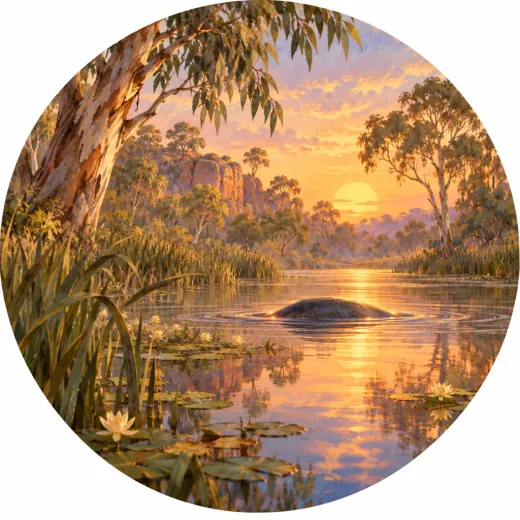
The Bunyip
bunyip, from an Aboriginal language of Victoria
a little scary
The bunyip is a creature that, according to stories gathered in south-eastern Australia, lives in swamps, rivers and the pools called billabongs. Nobody agrees on what it looks like: for some it has a dog's face and a horse's tail, for others a long neck or tusks, and for others still it is covered in feathers. At night its gloomy call is said to come from the water. In the nineteenth century European settlers talked about it too, and some newspapers even printed reports of sightings.
Did you know? According to some scholars, the bunyip's call could be the cry of the Australasian bittern, a swamp bird with a deep, gloomy song.
The story
The first time the brothers heard the call, it was night, and they were by the fire.
It had been a long day. They had taken the sheep to graze across the river, on a plain of dry grass where the only shade was a clump of gum trees. Towards evening they had reached a billabong, one of those big pools a river leaves behind when it changes course, where the water stays still and dark all year round. All around it grew reeds as tall as a man. On the bank, half sunk, lay dead logs with their roots in the air.
The older brother lit the fire. The younger one unrolled the blankets. The sheep, in a makeshift pen of branches, were strangely restless, and kept turning round and round.
“They're thirsty,” said the older one.
“Then why don't they drink?” said the younger.
It was true. The sheep were huddled in the far corner of the pen, heads down, all looking the same way: towards the water.
When the sun disappeared, the crickets stopped singing, all at once, as if someone had shut a door. What was left was a silence so full that you could hear every stick crackle in the fire.
Then, from the billabong, came the sound.
It wasn't a scream. It was a low, long boom, like a cow lowing inside a barrel, or like someone blowing with all their might into a gigantic bottle. It started from the water and rolled over the reeds, over the pen, over them. It made the tin mug on the ground rattle.
The younger brother pressed himself against the older one's shoulder.
“What is it?”
“An animal,” said the older one, not sounding sure.
“What animal?”
The sound came again. Once, twice, closer still. Each time, the sheep huddled tighter.
There were plenty of stories on the plain in those days. The brothers had heard them in the village, at the store, from shepherds coming back. People said that in the swamps of the south-east lived a creature called the bunyip. But nobody told the same story. For one, the bunyip had a dog's head and a horse's tail. For another, it was an animal with a very long neck, like a giant swan's. For someone else, it had tusks, or a body covered in feathers, or skin as smooth as a seal's. The one thing that came back in every tale was the voice: a gloomy call, at night, from the water.
The younger brother remembered what an older shepherd had once told him: that among his people, since long before the settlers came, the bunyip was something you remembered most of all when you went to play too close to dark water. “There's something down there,” they would tell the children. And the children, for a while, kept away from the banks.
“Let's go and look,” he whispered.
“Are you mad?”
“If we don't go, tomorrow we'll never know.”
The older one said nothing. Then he took a burning stick from the fire, held it up like a torch and went towards the reeds. The younger one followed a step behind, his hand gripping his brother's jacket.
They walked across the mud, which at that hour was cold and sticky and held their boots like a hand. Every step made a sound like a kiss, and at every sound the two of them stopped and listened, in case something down there answered. The reeds parted and closed behind them with a rustle. The air smelled of moss and rotting leaves.
Suddenly the call rang out so close that they felt it shake in their stomachs. The burning stick trembled. The younger brother had stopped breathing.
In front of them, just a few steps away, the reeds were moving.
There was no wind. They moved anyway, slowly, as if something big were in among them, pushing its way through.
The older brother raised the torch. The orange light slid over the reeds, over the surface of the water, over a long, dark shape the bank seemed to be hiding. For an instant, just one instant, two shiny points gleamed, at the height of their eyes.
Then the torch went out. A puff of air had blown it out.
In the dark, very close, something moved in the water. A low splash. Rings spreading outwards. Then the call once more, but further away, like an animal heading off towards the middle of the swamp.
The brothers ran back to the fire. They spent the night awake, sticks in their hands, shoulder to shoulder. Nothing else happened.
In the morning the sheep were all there, calm. On the bank there were no footprints, at least none of the kind that can be explained. Just churned-up mud, and a track through the reeds as wide as a person's body.
When the old shepherd saw them arrive with their tired faces, he didn't ask anything. He had them tell him the whole story, listened to the very end and then smiled, but without making fun of them.
“A bittern,” he said. “A swamp bird. It has a voice that seems to come out of the ground.”
The younger brother turned towards the billabong. “A bird?”
“Some say so,” the shepherd replied. “Others don't.”
In the nineteenth century, the newspapers were full of stories like this. They printed them next to the price of wool and the weather, with the same serious air. Someone wrote that they had seen something swimming in a river, someone that they had heard a strange cry in the night, someone that they had found a bone far too big. Every writer described a different beast, and every one swore they had seen the real one. A century and a half later, scholars read those pages and come up with theories: a bird, an extinct animal, a fear that takes the shape of the place where people live. Nobody has managed to get everyone to agree.
The older brother said nothing. He thought back to the black water, the two shiny points, the torch going out.
That evening, when the sun went down again, they moved the pen further from the bank. They lit a bigger fire. They kept the sheep safe.
And they waited, in silence, for the water to speak again.
A living tradition, told with respect: how we tell myths.
Relatives around the world
Listen / Read next
- Music to read by: Cinematic JourneyEpic film-style music, no lyrics, by Ciro Simone IrmiciSpotifyYouTube Music
Sources
- Robert Holden, Bunyips: Australia's Folklore of Fear (2001)
- National Library of Australia, Trove, nineteenth-century newspaper articles about the bunyip
