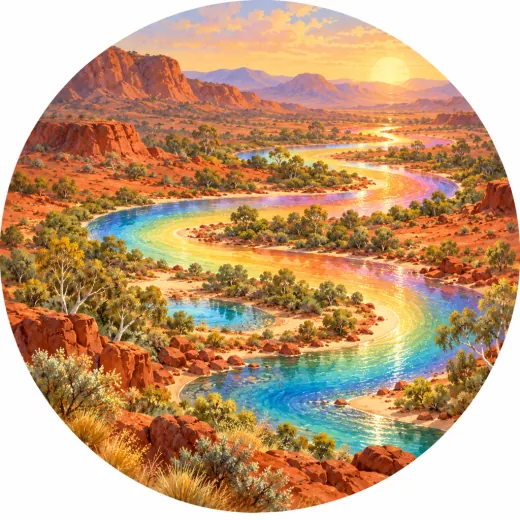
The Rainbow Serpent
known by different names in many Aboriginal languages
not scary at all
Many Aboriginal cultures of Australia tell of a great ancestral being in the shape of a serpent, linked to water, rain and the rainbow. In the public stories, as it moved across the land at the beginning of time, its body carved out riverbeds, gorges and waterholes. It is a powerful figure: it protects the sources of water, so precious in the desert, and those who do not respect the rules of the community may face its anger. Each people calls it by its own name and tells of it in its own way.
Did you know? The paintings of the serpent on the rocks of Arnhem Land are very old: scholars date them to thousands of years ago.
The story
Before we begin, a promise: I will tell you just one story, and I will also tell you that it is just one story among many.
The Rainbow Serpent does not belong to a single people. In many parts of Australia, Aboriginal people tell of a great ancestral being in the shape of a serpent, linked to water, to rain and to the rainbow. Each people calls it by its own name, in its own language, and tells it in its own way: sometimes it is male, sometimes female, sometimes both, sometimes it is kind and sometimes it is terrible. The one I am telling you is the simplest and most public form, the one that can be told to everyone. The others, the ones that belong to other people, are not mine.
In the beginning, they say, the land was flat and dry, and the heat lay over it like a blanket.
There were no rivers. There were no waterholes. There were no gorges, no rocks with shade beneath them. There was a hard, dust-coloured expanse, and under the dust something was sleeping.
It had slept for so long that its skin had taken on the colours of the earth, and nobody, not even the wind, remembered its breathing any more. Then, one day, it woke.
First the tail moved, and the ground shook. Then the body moved, as long as a river, and out of the dust came an enormous serpent, its scales shining with every colour: red like the sand, yellow like the sun, green like the grass that did not exist yet, blue like the sky after rain.
The serpent began to slide forward.
Wherever it went, its body pressed down on the earth and dug into it. A long furrow, deeper at every bend: it was the bed of a river. One great lash of its tail split the rock in two, and between the two walls a gorge was left, narrow and cool, where the shade lasted all day. Wherever the serpent stopped to rest, its weight left a round hollow, and into the hollow, from below, water rose. It was the first waterhole.
The serpent went back and forth, to and fro, unhurried and never losing its way, because every bend was a decision. Its path made the rivers, its resting places made the springs. And when it was happy and rose towards the sky, its body drew an arch of every colour in the misty air: the rainbow. That, they say, was how you could tell where it was going, from one waterhole to the next.
After the serpent came everything else. Plants began to grow around the water. Animals came to drink. And then came people, with their slow journeys, from waterhole to waterhole, from season to season, across the dry country.
The serpent, though, had not gone away. It had withdrawn into the deepest waters, and from there it kept watch.
Imagine a family, on a day at the end of the dry season. They had been walking for many hours. The children's lips were cracked, the old man was limping, the mother had stopped singing to save her breath. Then, at the end of a gorge, the waterhole appeared: dark, still water, ringed by rocks, with the sky inside it.
The children wanted to jump in. The old man stopped them with a single gesture.
“Wait.”
He went up to it slowly, bent down and spoke to the water in a low voice, the way you speak to someone older than you who lives in their own home. We don't know what he said: those words are not mine, and I don't know them. Then he waited. The water stayed still. A bird's wing passed over the surface without rippling it.
“Now,” he said.
They drank. Nobody shouted, nobody splashed, nobody took more than they needed. They did everything as it should be done, in silence, with respect, and the country let them pass.
Because the Rainbow Serpent protects the waters, and water, in the desert, is the most precious thing there is. Those who treat it well have something to drink. Those who respect it have a river. But imagine another story too, one of this kind, written by us: the sort you tell when you want children to listen carefully.
Once, let's say, someone came to a waterhole and didn't ask permission. He said the water belonged to everyone, that nobody could tell him what to do. He jumped in, splashed about, took more than he needed and wasted the rest.
Then, in a moment, the sky went dark. A hot wind came from the horizon, then thunder. The clouds sank until they touched the rocks. In the air there was a long sound, the rushing of an enormous body of water moving somewhere under the ground. The waterhole swelled. The riverbed, dry for months, filled in an instant with a brown flood, and the man was swept away, terrified and breathless, much further than he had ever wanted to go.
Nobody knows whether he came back, or how it ended. We won't say here, because it isn't the ending that matters.
What matters is that the water has a guardian. What matters is that country is not an object to be taken, but a home to be lived in by the rules of those who live there. And what matters is that the serpent is still there. The people who ask the waterholes for permission know it, and so do the young people who, after the first rain, look at the rainbow over the hills and fall silent.
For thousands of years, in Arnhem Land, in the north of Australia, the serpent has been painted on rock walls: a long, wavy body, with a big head and coils that look like a river. Those images are still there, under the overhanging rocks that shelter them from the rain, and anyone who looks at them today is looking at an idea that has travelled from one generation to the next, from grandparent to grandchild, without a break.
The Rainbow Serpent is not one story. It is many stories, and none of them is a fairy tale. The real stories belong to the Traditional Custodians of each people, and it is from them that they should be heard. Those who know how to listen lower their voices when they pass a spring.
A living tradition, told with respect: how we tell myths.
Relatives around the world
Listen / Read next
- Music to read by: Cinematic JourneyEpic film-style music, no lyrics, by Ciro Simone IrmiciSpotifyYouTube Music
Sources
- Australian Institute of Aboriginal and Torres Strait Islander Studies (AIATSIS), The Dreaming
- Paul S. C. Taçon and others, The Rainbow Serpent in Arnhem Land rock art, Antiquity (1996)
