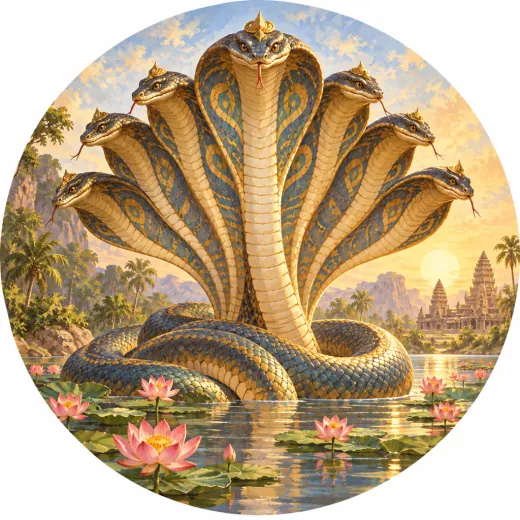
The Nagas
nāga, “serpent”, in Sanskrit
not scary at all
The nagas are divine beings in the form of serpents, sometimes with a human chest and face, who live in splendid kingdoms beneath the earth and under the waters. They guard treasures, springs and rain, and they can be generous protectors. The most famous is Shesha, the thousand-headed serpent on whom Vishnu rests between one age of the world and the next. Another, Vasuki, served as the rope when the gods and the demons churned the ocean of milk to obtain the amrita.
Did you know? In some parts of India, at the festival of Nag Panchami, milk and flowers are offered to images of serpents.
The story
Beneath the earth, where the sun never reaches, there is a kingdom that shines.
Its cities are called Bhogavati and Patala. Their streets are paved with gems that give off their own light, the houses are made of gold and crystal, and the gardens are full of flowers that never fade. This is where the Nagas live: beings shaped like serpents, who sometimes have the body and face of a man or a woman and wear crowns of rubies on their heads. They guard hidden treasures, springs and rains. They are powerful, and they are ancient. When it rains after a long drought, the old people say, it is because someone in that kingdom has decided to open a spring.
They were all born of the same mother. Her name was Kadru, and she had a thousand sons.
The greatest of them all was Shesha.
When Kadru tricked her sister Vinata into slavery, Shesha wanted nothing to do with it. He left his home and his brothers. He went up into the mountains, to the banks of the sacred rivers, into forests where no one speaks, and for years he stayed motionless, fasting, breathing nothing but air. His body grew thin and dry, but inside he was as clear as water.
Brahma, the creator, was moved. He came down to see him.
“Why do you torment yourself like this, Shesha?”
“I no longer want to live among those who have no sense of justice. All I want is peace.”
“You will have peace,” Brahma replied. “But first do me a favour. The earth does not keep still: it shakes, it sways. Go down into its depths and hold it up. Carry it on your head, so that it stands firm.”
Shesha coiled himself up, went down beneath the ground and placed himself under the weight of the world. From that day on, they say, the earth has not wavered. And between one age of the universe and the next, say the Puranas, Vishnu lies down to rest on his coils.
His brother Vasuki, on the other hand, remained king of the Nagas.
One day the gods and the demons, to obtain the amrita, decided to churn the ocean of milk. They had a mountain, Mandara, to use as the churning stick. But they needed a long rope and a strength that would not snap. They asked Vasuki. He agreed. The gods took hold of him at one end and the demons at the other; they pulled, and the mountain turned, and foam, vapour and smoke rose from the ocean. Vasuki breathed fire from the strain, and from his breath came black clouds and cool rain that refreshed the churners. The first thing to rise from the waves was a poison so strong that it threatened the world, and Shiva drank it, to protect everyone. Then, after other gifts from the ocean, the amrita came out.
But a curse still weighed on the Nagas.
Kadru, furious with the sons who had refused to help her with the trick, had said: “You will be burned in a sacrifice.” Brahma himself, they say, had let it happen, because some serpents had become too venomous for humans. Vasuki remembered those words every day, and could no longer sleep.
The gods told him how to protect himself. A sage named Jaratkaru lived alone and did not want to marry. But one night he saw his ancestors hanging upside down over an abyss, and he understood that he had to have a son to save them. He agreed to take as his wife a woman who had the same name as him, and who was offered to him as a gift. Vasuki had a sister, and her name was Jaratkaru too.
The sage set one condition: if she ever went against him, he would leave. One day, at sunset, she woke him so that he would not miss his prayers. He took offence and left anyway. But first he told her: “There is already a son in your womb, and he will save your people.”
The son was called Astika. He grew up quietly in the house of his uncle Vasuki, and studied the Vedas like an old sage.
The years went by. King Parikshit showed disrespect to a hermit, and the hermit's son, in his anger, foretold that within seven days the naga Takshaka would bite him. And so it happened. Parikshit's son, King Janamejaya, swore revenge. He announced a sacrifice so great that it would draw every serpent on earth into the fire.
The priests began to chant the mantras, and the smoke rose.
Beneath the earth, the Nagas felt a call they could not resist. One after another, small and large, white and black, they were dragged upwards, helpless, and fell into the flames. No one could stop those verses. Vasuki felt his own body pulling towards the fire, and he called his sister.
“Call your son. His moment has come.”
Astika set off, still only a boy. He reached the enclosure of the sacrifice, where the guards stopped him: he was too young. So he began to praise the king, the fire and the priests, with words so beautiful that Janamejaya ordered them to let him in.
“This boy speaks like an old sage,” said the king. “Give him whatever he asks.”
Meanwhile Takshaka, terrified, had run to hide with Indra. But the mantras dragged him upwards too, together with the god who was protecting him, and Indra, seeing the fire, abandoned him. Takshaka slid through the air towards the flames, trembling.
It was then that Astika raised his voice.
“King, I have praised you as you deserve. Now I ask you for a gift. Let the sacrifice end here.”
Janamejaya was troubled. He offered gold, cows, lands. Astika shook his head. “This is all I want.” The king was a man of his word, and although he would have liked to let his last enemy burn, he reluctantly ordered everything to stop.
They say that Astika said to Takshaka, three times: “Stay.” And Takshaka stayed hanging in mid-air, motionless, until the fire went out.
The serpents who were left hid beneath the earth, and no one ever burned them again. When they learned who had saved them, the Nagas made a promise: anyone who remembered the name of Astika, by day or by night, would never again have anything to fear from serpents.
And so the Nagas were saved by a boy with the blood of two worlds, and by a king who kept his word.
A living tradition, told with respect: how we tell myths.
Relatives around the world
Listen / Read next
- Music to read by: Cinematic JourneyEpic film-style music, no lyrics, by Ciro Simone IrmiciSpotifyYouTube Music
Sources
- Mahabharata, Book I
- Vishnu Purana
