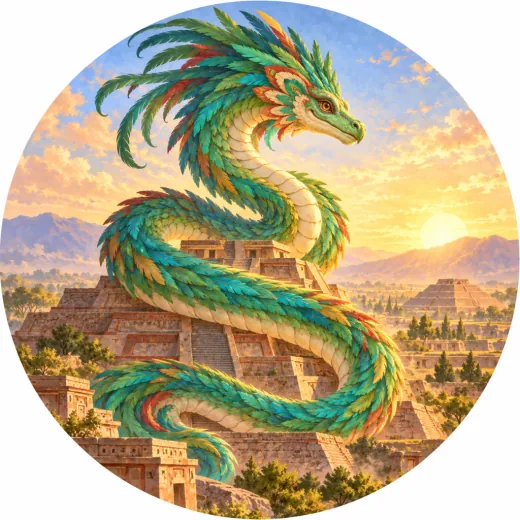
Quetzalcóatl
“feathered serpent”, in Nahuatl
not scary at all
Quetzalcóatl was the “feathered serpent”, a deity of wind, knowledge and learning. He was pictured as a serpent covered in the green feathers of the quetzal, a beautiful forest bird. The Aztecs told that, when the world was created anew, Quetzalcóatl went down into the land of the dead to recover the bones of the people of past ages and, by sprinkling them with his own blood, gave life to the humans of today. It was also said that he gave people maize, after following an ant to the mountain where the seeds were hidden.
Did you know? The quetzal, the bird whose feathers he wore, is now the national symbol of Guatemala, and the country's currency is called the quetzal too.
The story
In the kingdom of the dead there is no light, and that day a god went down into it on foot.
The world had already known four Suns, four ages, and each one had ended badly. The first, when jaguars devoured the people. The second, when a tremendous wind swept them away. The third, under a rain of fire. The fourth, in a flood, and the people had turned into fish. The people of those times were dead, and their bones rested in Mictlan, the kingdom of the dead, ruled by Mictlantecuhtli. Now the Fifth Sun was about to begin. The sky was ready, and so was the earth. What was missing was someone to live there.
“Who will live down there?” the gods asked. For a while no one answered, because to find a human being you had to go where human beings had ended up.
Quetzalcóatl, the Feathered Serpent, stepped forward. “I'll go. I'll go and fetch the precious bones.”
He went down along roads without wind, into a darkness so thick that not even a god could see his own hands. Under his feet he felt the dust of everyone who had passed that way before him. He came before Mictlantecuhtli, who sat among the bones, white, orderly, patient, and said, “I have come to take the precious bones you keep.”
“And what will you do with them?” asked the Lord of the Dead.
“The gods are wondering who will live on the earth.”
Mictlantecuhtli was silent for a while, then said, “Very well. Blow my conch shell, and walk four times around my circle.”
The conch had no holes. How could anyone make it sound? Quetzalcóatl thought about it, then called some worms, and the worms bored holes right through it. He also called some bees, and the bees went inside the shell and buzzed there all together, as if in a hive. The sound spread through the kingdom of the dead, deep and sweet.
Mictlantecuhtli heard it from far away. “Very well,” he said. “Take them.”
But then he changed his mind. He called his servants: “Tell that god to leave the bones where they are.”
Quetzalcóatl replied, “No. I'm taking them for ever.”
His double, who spoke into his ear, whispered, “Tell them: I'll leave them.” Quetzalcóatl did as it said. “I'll leave them,” he told the servants. Meanwhile he had already gathered up the bones and was carrying them off.
The Lord of the Dead flew into a rage. “Dig a pit!” he ordered his servants.
Quetzalcóatl ran. But he did not see the pit in the dark, and he fell into it. At that moment a rustle of feathers rose out of the darkness, a beating of wings, a cry. Some quails flew up just a few steps away and frightened him: the god fell down in a faint, as if dead. The bones slipped from his hands and scattered everywhere, and the quails, curious, pecked and nibbled at them one by one.
When he came round, Quetzalcóatl wept. “What do I do now?” he asked his double.
“What can be done?” it answered. “That's how it went. Let it be so.”
The god got up. One by one he gathered the broken bones, tied them in a bundle, and climbed up out of the dark into the light. He took them to Tamoanchan, the place where things are born. The bundle was light, but the god felt as if he were carrying a whole world.
There the goddess Cihuacóatl ground them in a precious bowl until they became powder. For a long while nothing could be heard but the sound of the grinding stone, as when bread is being made. Quetzalcóatl cut himself and let his blood fall onto the dough. Then the other gods did penance too, one after another, each offering something of themselves.
“The macehuales are born,” they said. It means “the deserved ones”: the people born thanks to the sacrifice of the gods.
Now there were people, but they were hungry. They walked under the Fifth Sun, looked up at the sky, and had no idea what to put in their mouths.
The gods wondered what they could eat. Quetzalcóatl began to search. Early one morning he saw a red ant hurrying along with a grain of maize on its back, heading for a mountain called Tonacatepetl, the Mountain of Our Sustenance.
“Ant, where did you find that?” he asked.
The ant did not answer. It kept walking without stopping.
He insisted. “Tell me. Where did you get that grain?”
The further the ant went, the more the god followed it. In the end, tired of being pestered, the ant said, “Come.”
Quetzalcóatl turned himself into a black ant. He followed his companion to the foot of the mountain, went in with it through a tiny crack and came into a hall full of seeds of every colour, white, black, yellow and red. He took a handful and crept out on tiptoe, like a thief.
He took them to Tamoanchan. The gods chewed them and put them in the mouths of the human babies, so that they would grow strong. That is how humankind learned to eat maize.
Quetzalcóatl, though, wanted to carry off the whole mountain. He tied it up with ropes and tried to lift it. He could not. It was too heavy, even for a god.
He asked the advice of two diviners, Oxomoco and Cipactonal, who cast lots with grains. The signs said, “Nanahuatzin will open the mountain.”
Nanahuatzin came up and split the mountain open. There was a sound like thunder, and seeds began to fall from the cracks like rain. At once the Tlaloque arrived, the lords of the rain, in every colour: white, black, blue, yellow, red. They stole the seeds of white, black, yellow and red maize, and the beans, and the amaranth, and the chia. What the god had not managed to carry off on his own, the rain brought down to the earth.
And so the maize, which had been shut inside a mountain, came into human hands.
And every time you eat a tortilla, remember that someone went down into the dark, fell into a pit, gathered up the broken bones, gave his blood so that you could live, and then followed an ant.
Relatives around the world
In the trails
Listen / Read next
- Music to read by: Cinematic JourneyEpic film-style music, no lyrics, by Ciro Simone IrmiciSpotifyYouTube Music
Sources
- Leyenda de los Soles (1558)
- Bernardino de Sahagún, Florentine Codex (about 1577)
