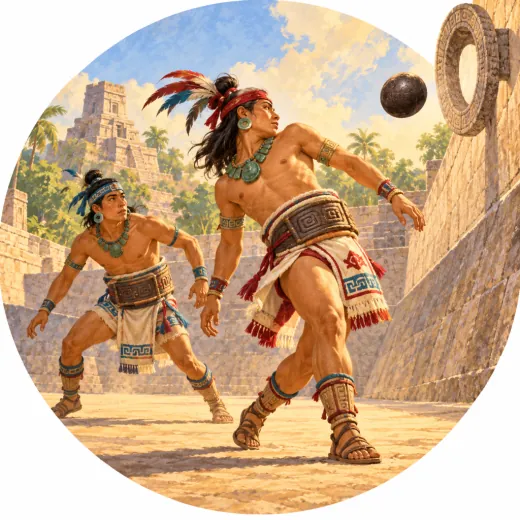
The ballgame
ullamaliztli in Nahuatl, pitz in Maya
not scary at all
All over Mesoamerica, for more than three thousand years, people played with a heavy rubber ball, hitting it with their hips without using their hands. The courts were long stone alleys, and some had stone rings high up on the walls: getting the ball through the ring was a very rare feat. It was not just a sport: according to scholars the flight of the ball recalled the journey of the sun, and in the myths the twins of the Popol Vuh play against the lords of the land of the dead. The largest court is at Chichén Itzá: its enclosure, platforms included, is about 168 metres long.
Did you know? Europeans had never seen rubber: in 1528 Cortés took some players to Spain, where they performed before Emperor Charles V.
The story
At dawn, on the court, there is a sharp sound. Tock.
Then another. Tock. And another, further off, bouncing between two stone walls. It is the sound of a heavy ball striking a hip and flying back into the air. The players do not use their hands, or their feet: they use their hips, their thighs, their elbows. The ball is solid rubber, as big as a head, and harder than you would think. If it hits you wrong, it leaves a bruise the size of a plum. That is why the players tie wide padded belts round their hips and protect their knees: rubber on bare skin hurts, and a match can last for hours.
The court is a long corridor between two high walls with sloping, stepped sides and a wide strip of beaten earth in the middle. There is no goal, no net. But high on the walls, more than six metres above the ground, two great stone rings jut out, their holes facing the sky. Getting the ball through one of those holes is an almost impossible feat. When it happens, the player who does it is remembered for generations.
At Chichén Itzá, in Yucatán, there is the biggest court of all: its enclosure, with the walls and platforms, is about a hundred and sixty-eight metres long. For more than three thousand years, all over Mesoamerica, the game was played like this.
But the Maya and their neighbours knew this was not just a game. To understand why, we have to go back to a story: the story of the brothers.
The Popol Vuh tells of two brothers, Hun Hunahpu and Vucub Hunahpu, great ball players. They played every day on a court near a road that led down underground. Beneath that court lay a kingdom, Xibalba, where the lords of the dead lived. One day one of them, Hun-Camé, heard a noise above his head. Tock. Tock. Tock. A steady, nagging noise that would not let him sleep. A noise that reminded him, every time, that up above someone was alive and having fun.
“Who is disturbing our peace?”
The lords sent messengers to invite the brothers to come down and play. The brothers accepted. They did not know that tricks were waiting for them. They went down, and they did not come back.
For a long time, in the world above, the court stood empty. Then their sons were born, twins, Hunahpu and Xbalanque. They grew up clever and quick, and one day, in their grandmother's house, they found a ball and leather gloves that had belonged to their father. They began to play. Tock. Tock. Tock.
Underground, the lords of Xibalba looked at each other. “Again?”
They sent the same invitation. The twins listened to the messengers, looked at each other and said yes. This time they knew everything.
Before leaving, the twins planted two little maize plants in the middle of their grandmother's house. “As long as they stay green, it means we're alive,” they said. Their grandmother looked at them every day, her heart tight, and every day they were green.
The journey was long and full of traps. The lords made them sleep in the houses of trial: the Dark House, the House of Razors, the House of Cold, the House of Jaguars, the House of Fire, the House of Bats. In each of them they were supposed to die. The twins did not die. In the Dark House, for example, they had to keep a pine torch and a cigar alight all night without burning them down: they put fireflies in place of the fire, and nobody noticed.
At last, in Xibalba, came the match. The lords sent out their own ball, and inside it, hidden, was a flint knife. The twins took a good look. “Not this one,” they said politely. “We'll play with ours.” And they played. Tock. Tock. Tock. Nobody won straight away, but that evening the court of Xibalba rang with a new sound.
Then, for a while, the twins were thought to be dead. They came back to life disguised as two strange performers who danced, leapt into the fire, vanished and reappeared as if it were nothing. The lords watched them open-mouthed. “Do it to us too,” they said.
The twins did it, halfway. For the lords, the trick worked only once. And the kingdom of the dead, which for so long had feared nobody, was afraid for the first time, of two boys with a ball.
When it was all over, the twins revealed who they were. And they rose up. Hunahpu became the sun, and Xbalanque the moon. That, according to the Popol Vuh, is how light began in the world.
That is why the ancients, when they looked at the court, did not see just a contest. They saw the sky. The ball going from one side to the other, rising, falling, rising again: scholars think it recalled the sun's journey across the sky, and its journey under the earth at night, where the dead wait. The match was a prayer too, and like every prayer it could be played well or badly.
After the Spaniards arrived, the game did not vanish at once. A friar, Diego Durán, wrote a history of the lands of the Mexica, and in its pages he described the game: the rubber, the hips, the skill. The rubber above all amazed him. Europeans had never seen it.
In 1528, Hernán Cortés returned to Spain from Mexico and took some players with him. He presented them to the Emperor Charles V.
Try to picture the scene. A stone courtyard in Spain, with ladies and knights gathering in a circle. Men from the other side of the ocean take off their cloaks and, without a word, start striking a dark, heavy ball with their hips. Tock. Tock. The ball flies higher than any leather ball could. It bounces off the stones. It comes back. No knight knows what to say. Somewhere, a page drops a tray.
Meanwhile, on the other side of the sea, on a stone court under the Yucatán sun, someone was striking the ball with a hip. Tock.
Just as the sun does, every day: it rises, it passes, it falls, and it starts again.
Relatives around the world
Listen / Read next
- Music to read by: Cinematic JourneyEpic film-style music, no lyrics, by Ciro Simone IrmiciSpotifyYouTube Music
Sources
- Popol Vuh, translated by Dennis Tedlock (1985)
- Diego Durán, History of the Indies of New Spain (1581)
