The Five Suns
the legend of the Suns
a little scary
The Aztecs believed that the world had already been created and destroyed four times, and that each age had had its own sun. The first world ended devoured by jaguars, the second was swept away by the wind, the third was burned by a rain of fire and the fourth was drowned by a flood. The fifth sun, ours, was born at Teotihuacan, when a small, humble and sickly god found the courage to throw himself into the sacred fire and came out shining. This world too, they said, will end one day.
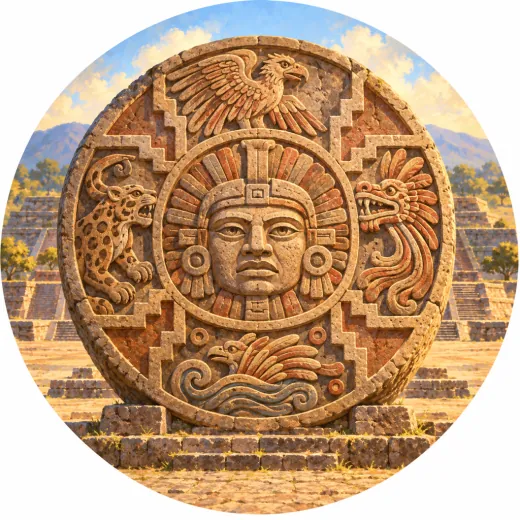
Did you know? The famous Aztec “Sun Stone”, in the National Museum of Anthropology in Mexico City, depicts the five Suns.
The story
The Aztecs said something that sounds frightening at first: the world has already ended four times.
Each world had had its own Sun, and each Sun had lasted until the gods grew tired of it, or it grew tired of the people. Then everything had collapsed, and another world had begun.
The first Sun was called Four Jaguar. In that world, they said, lived giant people, as strong as oaks, but they did not know how to grow maize and ate whatever they could find. One day the jaguars came out of the forests and devoured every one of them. The Sun went out, and the world was empty.
The second Sun was called Four Wind. It lasted until a storm began to blow and never stopped. It tore down the houses, ripped up the trees and carried people off like leaves. Those who managed to cling to the branches, they said, became monkeys, and they still leap through the trees today.
The third Sun was called Four Rain. But it was not water that fell: it was fire. A burning rain came down from the sky, and the few who survived, they said, turned into birds and flew far away.
The fourth Sun was called Four Water. For fifty-two years the sky poured water onto the earth, and the world disappeared beneath it. But a god called Titlacahuan had warned two people, a man and a woman, to hide.
“Hollow out the trunk of a great ahuehuete tree,” he said. “Climb inside and close up the opening. Take one ear of maize each, and eat nothing else.”
The two obeyed. The water came, as high as the sky, and the trunk floated in the dark. When the water drew back, the two climbed out, starving. They saw a fish darting in a pool, roasted it over a fire and ate it.
The smoke rose all the way to the sky.
Titlacahuan was furious. “What have you done?” he said. “I told you to eat nothing but maize.” And as a punishment he turned them into dogs.
The last world, too, was gone.
Then there was only darkness.
The gods gathered at Teotihuacan, the place of the gods. The sky was black, with no stars, no moon, no sun. No one could see the face of the god beside him.
“We must make a new world,” said one of them. “But to see where to put it, we need a Sun. Which of us has the courage?”
There was a long silence.
Tecuciztecatl, the rich god, stepped forward. He wore a cloak of feathers and jewels. “I will do it,” he said.
“We need another,” said the same voice, “someone to go with him.”
No one stepped forward. The gods looked at one another, heads bowed. In the end someone pointed to a small god standing apart, who never spoke. It was Nanahuatzin. His body was covered in sores and scabs, and nobody had ever invited him to a feast.
“It is your turn,” they said.
“Very well,” he answered simply. “As you wish.”
For four days the two prepared themselves with penance. The gods lit a great fire in a stone hearth and fed it night and day.
Tecuciztecatl brought precious things as his offering: beautiful balls of feathers, branches of gold, thorns of jade, sweet-smelling incense. Nanahuatzin brought what he had: nine reeds tied in three bundles, agave thorns, and instead of incense, his own scabs. They were poor things. But he offered them with all his heart.
Then, at midnight, the fire was as high as a mountain. The gods lined up in two rows.
“Tecuciztecatl,” they said, “go. Throw yourself in.”
The rich god ran towards the flames. He felt the heat on his face. He stopped.
He tried a second time. He stopped.
He tried a third time. He stopped.
He tried a fourth time, and again he froze, trembling. He could not do it.
“Nanahuatzin,” the gods said then. “Your turn.”
The little god closed his eyes. He did not run. He did not hesitate. He walked straight towards the flames, like someone stepping into a house he knows, and threw himself in. The fire crackled. Then there was no sound at all.
At that, Tecuciztecatl, ashamed, found his courage and threw himself in too. An eagle followed them into the fire, and its feathers stayed dark for ever. Then came a jaguar, but later, when the fire had already burned low, and so it came out only spotted with dark patches.
The gods waited in silence, gazing towards the four directions of the world, not knowing where the light would come from.
It was in the east that the sky turned red.
The Sun rose. It was so bright that no one could look at it, and behind it, in the same place, rose another light just as dazzling. It was Tecuciztecatl. Two equal suns would have burned up the world.
So one of the gods picked up a rabbit and threw it in the second one's face. Its light grew dimmer, and the shape of a rabbit stayed on its face for ever. That is how the Moon was born, and anyone who looks at it on a clear night can still see the rabbit.
But the Sun, high in the sky, did not move.
“Why doesn't it travel?” the gods asked one another.
The Sun answered: “I will not move until you have given your lives, as I gave mine.”
The gods understood. The new world could not stand without a great gift, and so they decided to offer themselves. When it was done, Ehecatl, the god of the wind, blew with all his strength, and the Sun, pushed by that breath, set off on its way at last.
And so the fifth Sun was born, our Sun, which the Aztecs called Four Movement, because it moves.
They also said that one day this Sun will end in earthquakes and famine, like the others. But there was one thing they never forgot. The Sun had not been born from the richest or the strongest, but from the one who had the courage to jump first.
In Mexico City, in the Museum of Anthropology, there is a great round stone, the Sun Stone, with the face of the Sun in the middle and, around it, the signs of the four worlds that came before. Anyone who looks at it closely will notice: the four worlds are there, gathered tightly around the fifth, as if they were waiting.
Relatives around the world
Listen / Read next
- Music to read by: Cinematic JourneyEpic film-style music, no lyrics, by Ciro Simone IrmiciSpotifyYouTube Music
Sources
- Leyenda de los Soles (1558)
- Bernardino de Sahagún, Florentine Codex, Book VII
