The Founding of Tenochtitlan
the eagle on the cactus
not scary at all
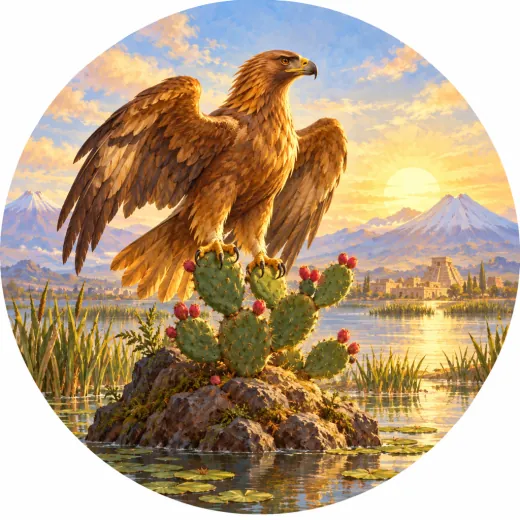
The Aztecs, also called the Mexica, told that they had set out from a faraway land called Aztlán. For a great many years they travelled in search of the right place, guided by their god Huitzilopochtli. The sign to recognise it would be this: an eagle perched on a prickly pear cactus growing from a rock in the middle of a lake. They found it on a marshy islet in Lake Texcoco, and there they built their capital, Tenochtitlan, which became one of the largest cities in the world.
Did you know? The eagle on the cactus is at the centre of the flag of Mexico, and Mexico City stands exactly where Tenochtitlan once was.
The story
Some journeys are so long that, after a while, nobody remembers why they began.
The journey of the Aztecs, who also called themselves the Mexica, lasted for generations. The grandparents set out from Aztlán, the land of their beginning, a place of waters and white herons whose edge no one had ever seen. The children were born along the way. The grandchildren inherited the road the way you inherit a name.
At the front of them all, carried on the shoulders of the priests, went the god Huitzilopochtli. He was a bundle wrapped in cloth, and to anyone who did not believe he looked like nothing more than a parcel of rags. But the priests said the god spoke. At night, while the camp slept, he told them where to go and where to stop.
So they stopped at Coatepec, and for a while they thought of staying. Then they moved on. They stopped at Chapultepec, the hill of the grasshoppers, and there their neighbours began to give them dark looks. There were too many of them, they were strangers, and they talked about a god nobody knew. Every time they found a home, someone drove them away.
“Where are we going?” a young boy would ask in the evening, by the fire.
“Home,” whoever was sitting next to him would answer.
“But which home?”
Nobody could say. Only the god knew.
Then came the year when Huitzilopochtli spoke more clearly than ever.
“You must not stop in other people's lands,” he told the priests. “Your place is in the lake. Look for a place where you will find a cactus, a tenochtli, growing out of a stone. It was the heart of Copil, my nephew, who betrayed me: it was thrown among the reeds, and the cactus grew from it. On top of the cactus you will see an eagle. When you see it, stop. There your city will rise. There you will be great.”
The news passed from mouth to mouth through the whole camp. They set off that very night.
Lake Texcoco was a wide stretch of shallow water among the mountains. Powerful peoples lived on its shores, with stone cities and markets. Out in the water, though, there were only little islands of mud and reeds. Nobody wanted them. The birds nested there, and the mosquitoes did the rest.
The Mexica waded through the reeds with the water up to their knees. The priests went first, testing the bottom with their sticks. Behind them the fathers carried the children on their shoulders, and the mothers carried the bundles. The only sounds were the splash of their steps and, now and then, the cry of a bird taking flight.
It was then that they began to notice the signs.
The first was a spring. In that spot the water was clear and white as milk, and all around grew white reeds and white willows; white fish darted in the water, and white frogs jumped on the banks. In a land of dark mud, that corner looked like a blank page, still waiting to be written.
“This is it,” said one priest. “The god told us.”
“The god told us to look for a cactus,” answered another.
They walked on, and night caught them among the reeds. There was no fire, because the wood was wet, and no one could sleep. Mosquitoes whined in their ears, the cold rose from the water, and a woman whispered, so the children would not hear, that perhaps this lake never ended. The god's bundle, propped on a heap of reeds, was silent. No one dared say out loud what everyone was thinking: what if there was no sign at all?
Little by little the sun rose over the edge of the lake, and the world turned gold.
And at that moment, right in front of them, an islet appeared.
It was small, hardly more than a lump of mud and grass. But in the middle of it, among the reeds, there was a rock. Out of the rock, growing between two cracks, rose a cactus heavy with prickly pears, the kind that are red as fire. And on top of the cactus, its wings spread towards the sun, perfectly still, sat an eagle.
No one spoke. Some people knelt down in the water. A man called Tenoch, who was leading them, took a step forward and laid a hand on his chest, as if to stop his heart from racing.
“It is the sign,” he whispered. “We have arrived.”
The eagle looked at them. Then, when the children began to shout for joy, it opened its wings and rose into the air, and it seemed to carry the sky away with it.
It was the year 2 House, say the painted books: in our calendar, 1325.
That evening the Mexica lit a fire at last, roasted their first wild ducks and ate sitting on the grass, tired and silent, with the strange feeling that they would never have to leave again. Then they built a temple for their god. It was not made of stone, because nobody had any stone: it was made of reeds and mud, with a straw roof. It was small and crooked, but to them it was the most beautiful temple in the world.
The early days were very hard. They had to fish, hunt ducks, and sell fish and frogs to buy a little stone and wood. The rulers of the cities on the shore left them alone, because the islet was worth nothing. But little by little, the Mexica built. They filled the lake with small floating fields and grew maize and flowers. They dug canals, raised bridges, and divided the island into four quarters, just as the Codex Mendoza shows, with four strips of blue water running alongside the stone and the eagle.
The place was called Tenochtitlan: “by the stone cactus”, according to one explanation. Another says the name comes from Tenoch, the old leader who had seen the eagle. Perhaps both are true.
A hundred years later, that city had streets of water, palaces of red stone, markets where you could buy anything, and gardens where flowers grew on the lake. Travellers who saw it for the first time thought they were dreaming.
Today Tenochtitlan is gone. Mexico City stands on top of it, with its skyscrapers and its streets full of cars. But where the island once was, on the flag that flies over the great square, there is still an eagle on a cactus. It looks straight ahead, as it did back then, and waits for someone to stop.
Relatives around the world
In real history
Listen / Read next
- Music to read by: Cinematic JourneyEpic film-style music, no lyrics, by Ciro Simone IrmiciSpotifyYouTube Music
Sources
- Codex Mendoza (about 1541)
- Diego Durán, Historia de las Indias de Nueva España (1581)
