Chaac
Chaak, in Maya
a little scary
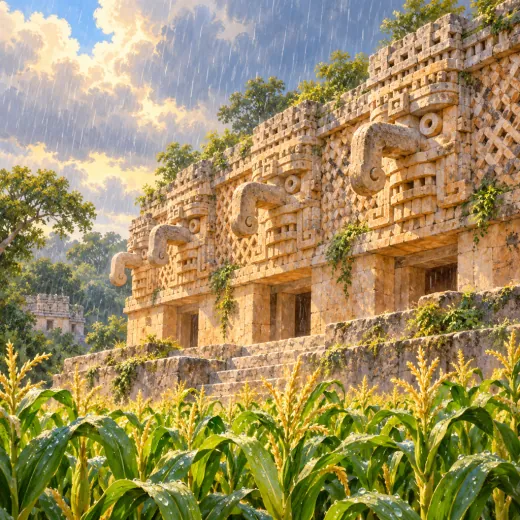
Chaac was the Maya god of rain and lightning. With his stone axe he struck the clouds to make thunder and send rain down onto the maize fields. On the Yucatán peninsula there are no rivers above ground, and rain was everything: that is why his faces, with a long curved nose, are carved by the dozen on the fronts of palaces in cities such as Uxmal. People also believed there were four Chaacs, one for each direction of the world.
Did you know? In the Yucatán, water is found in cenotes, large natural wells in the rock: for the Maya they were also doorways to the underworld.
The story
In Yucatán there are no rivers.
People who go there for the first time find it strange: a flat plain covered in low forest, with ground so thin and full of limestone that storm water vanishes in an instant, as if the earth were a sponge. Its real river runs underneath: in caves, in wells, in the great holes that the Maya called dzonot and that we call cenotes.
For a farmer on that plain, then, rain was everything. When it came, the maize grew. When it did not, there was only dust.
That year the dry season had gone on far too long.
The man had burned his field on the right days, as had always been done. He had made a row of holes with his stick and dropped seeds into each one, and waited for the clouds. The clouds had not come. Every morning he climbed onto a stone and looked east, where the sky grew pale, empty and always the same.
“Dad,” said his son, “why doesn't it rain?”
“Because Chaac hasn't picked up his axe yet.”
The boy knew about Chaac. He had seen him on the walls of the great palaces, on market days, when his father took him to the city: a stone face with round eyes, a long nose curling like a trunk, and fangs poking out at the sides of the mouth. There were dozens of them, one above the other, all over the front of the building, as if the palace were made of nothing but faces. They were a little frightening.
“Chaac is good,” said his father, who had read the fear in his eyes. “But to wake him, you have to deserve it.”
That evening, after sunset, the man set off with an empty jar. His son followed him in silence.
The cenote was half an hour's walk away, hidden in the forest. You came out in front of a hole in the rock, wide and round like an eye. Inside, at the bottom, far below, was the water: still, dark, motionless. It had the shape of the sky, but it was deeper. The Maya said that down there another world began, and that these were the only doors into it.
The man climbed down first, holding on to the roots. The boy watched him disappear, swallowed by the dark. Then he heard the sound of the jar sinking and filling. Up in the forest the cicadas had stopped singing, and the boy, alone on the edge, had the feeling of being watched by something very large and very patient. He gripped a root, counted to a hundred, then to two hundred. When his father's head appeared again over the rim, with the jar tied to his back, the boy realised he had been holding his breath.
That water, taken from where no hand had ever touched it, was not for drinking. It was for the ceremony the next day.
The next morning, in front of the hut, the village priest and four old men had set out a table of branches on the ground, with maize bread, honey, and incense smoking as it burned. The old men were the chaques, four like the Chaacs, and they stood at the four sides of the table. They prayed all day long. They sang and stamped their feet. Then, towards evening, a frog began to sing in the ditch.
Then another.
Then ten, twenty, a hundred, all together, at the tops of their voices.
“Listen,” his father whispered to the boy. “The frogs always know before we do.”
That night, without anyone knowing how, something in the air changed. It grew heavier, damper. The boy could not sleep. He went out in front of the hut and looked at the sky.
At dawn, in the east, the first cloud appeared. It was red as glowing embers. “Chac Xib Chac,” said his father, and everyone stopped to greet it. It was the Chaac of the east.
Then from the north came another, white as milk. Then a black one from the west, low and heavy. Then, in the south, a yellow one, shining like pollen.
The four Chaacs, the ones from the four corners of the world, one for each direction, were drawing near to their valley.
At the edge of the sky, where the clouds met, the boy caught a glint: it was the axe. It looked like smooth stone, as big as a door. Someone lifted it slowly above a cloud, and let it fall.
The lightning flashed. The thunder came a moment later, so loud that the turkeys ran to hide under the huts. The boy covered his ears, but he was laughing.
And then came the rain.
It came straight down, by the bucketful, like a shower of stones. It came with the smell of earth and wet rock. The boy ran outside with his arms wide, his head tipped back and his mouth open. The leaf gutters filled in a moment. The field, burned and cracked, drank until it was swollen. The water slid into the holes in the rock, found its underground road again and filled the cenote to the brim.
For three days it did not stop.
His father, sitting under the straw roof, looked at the field with his eyes full of tears and said nothing.
When he heard a new sound, a green rustling, the boy poked his head out. The first maize shoots had sprung up from the black earth, all at once, as if someone had called them.
“You see?” said his father, smiling. “Now you know why Chaac's faces are on all the palaces.”
In the painted books of the Maya, the few that survived, like the Dresden Codex, Chaac is always on the move. You see him with his axe raised, with a serpent coming out of his hands like a bolt of lightning, or with an upturned jar pouring out water. He is never still: for the Maya, rain was a job that someone did for them.
Even today, at Uxmal, at Kabah and in many cities of Yucatán, his face with its curved nose looks out from the stone walls, and at Kabah there are hundreds of them, side by side, on a single building. The Maya did not put them there to frighten anyone. Perhaps they put them there so that Chaac would remember the valley, even in the seasons when the dust lasts too long.
Relatives around the world
In the trails
Listen / Read next
- Music to read by: Cinematic JourneyEpic film-style music, no lyrics, by Ciro Simone IrmiciSpotifyYouTube Music
Sources
- Dresden Codex (11th–12th century)
- Diego de Landa, Relación de las cosas de Yucatán (about 1566)
