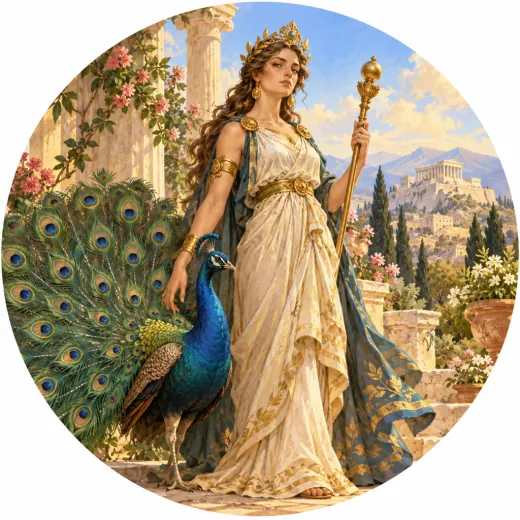
Hera
Hḗra, in Ancient Greek
a little scary
Hera is the wife of Zeus and the queen of Olympus, protector of marriage and of families. In the myths she is often jealous and vengeful, because Zeus is unfaithful to her many times, and she takes it out on his rivals and their children: the hero Heracles was hunted by her all his life. Her animal is the peacock. One story tells that the giant Argus, who had a hundred eyes, worked for her; when he was defeated, Hera placed his eyes on the peacock's tail.
Did you know? According to Hesiod, Hera was a daughter of Cronus and Rhea, and it was she who raised the Hydra, the monster Heracles had to face.
The story
Every evening, when the sun sets behind the mountains, the lamps are lit on Olympus and Zeus sits down to dinner with the other gods. Beside him, on the highest throne after his own, sits a woman with a crown and a straight, steady gaze. She is Hera, the queen.
She is the daughter of Cronus and Rhea, and Zeus chose her out of all the goddesses to be his wife. She ought to be the happiest goddess in the world. Instead, there is one problem that spoils every dinner: Zeus can never stay put.
Hesiod tells us that one day Hera was so furious with him that she gave birth to a son on her own, without him, just to spite him. He tells us that, to punish the hero Heracles, born of another woman, she raised a monster with many heads: the Hydra. Hera does not forget. Hera keeps watch.
That was why, one summer morning, she noticed a cloud.
The sky over Greece was clear. No wind, no rain. And yet, above a field near a river, there hung a dark cloud, perfectly still. “Strange,” said Hera. “Night doesn't fall in the daytime.”
She came down to look, and the cloud melted away. Where a moment before there had been a man and a girl, there was now only a white heifer, very beautiful, grazing on the grass. The girl's name was Io, and she was the daughter of the river god Inachus. And the heifer was her.
According to Ovid, it was Zeus who had transformed her, to hide her from his wife's eyes. Other poets, older ones, say it was Hera herself who did it. Here we follow Ovid.
Hera pretended not to understand. She went up to the heifer and ran a hand along its snow-white back.
“What a lovely animal,” she said. “Whose is it? Where does it come from?”
Zeus, embarrassed, answered that it had sprung from the earth, in a place that belonged to no one. Hera looked him straight in the eye and did not believe him for a moment.
“Give her to me,” she said.
If he refused, the goddess would know. If he agreed, he would lose Io. Zeus gave in. Hera led the heifer away with a blade of grass round her neck and handed her over to a guard who never slept.
His name was Argus. He had a hundred eyes, scattered over his head and body, and he only ever closed two at a time, taking turns, while the other ninety-eight kept watch. At night he could see in the dark. By day he could see behind him. No thief had ever got past.
For Io, a long time began. By day she grazed on thin grass; by night they tied her to a tree on a short rope. Above her, in the dark, shone the eyes of her guard, which never all went out at once. No one spoke to her. When Argus looked at her, she felt a hundred stares settle on her skin, one beside the other, like drops of cold rain. Once, on the bank of her father's river, she saw her own reflection for the first time: the head of a heifer, with horns. She tried to scream, and out of her throat came a moo. It frightened her so much that she ran away.
She came to her sisters, the river nymphs, who stroked her without knowing who she was. She came to her father, Inachus, who gave her grass to eat and talked to her as if to a friend. Then Io bent down and, with her hoof, traced two letters in the dust. Her name.
Inachus read it and sank down on the bank. “I was in torment because I was searching for you,” he said, weeping. “And this is how I find you.”
But Argus allowed nothing more. He took the heifer, led her back to the hills, and watched her with a hundred eyes.
Zeus watched from above, and suffered. He called his son Hermes, the messenger, the cleverest of the gods. “Free Io,” he said. “However you like, but free Io.”
Hermes put aside his winged sandals and his hat, kept a staff, took a pipe made of reeds and came down to earth dressed as a shepherd. Driving a few goats in front of him, he climbed the mountain playing a slow tune. Argus, who had been bored for centuries, listened.
“Sit here in the shade,” he said. “I've never heard music like that.”
Hermes sat down. He played. He talked for hours. He told the story of a nymph called Syrinx, who escaped the god Pan by turning into a reed, and how Pan made the very first pipe out of those reeds. As he told it, the music grew slower and his voice grew lower. One by one, Argus' eyes began to close. First twenty, then fifty, then eighty. Hermes kept talking softly. The last five held out for a long time. Then they closed too.
Argus never woke up again.
When Hera heard the news, she went up the mountain and stood there in silence for a long time. A hundred eyes, one by one, still seemed to be looking at her. Then she did something new. She took them all and set them on the feathers of the bird she loved most, the peacock. Ever since, its tail has shone with a hundred eyes of blue and gold, which open whenever it spreads its feathers.
Then she sent a Fury after Io, who drove invisible goads into her breast and chased her without rest across half the world, over seas and mountains. Io ran and ran, until she reached the banks of a great river, the Nile. She fell to her knees, raised her eyes to Zeus and begged for it to end.
Zeus swore to Hera that he would never love that girl again. And so the goddess, with a sigh, gave up her revenge.
The white hide fell away. The horns shrank back. The hooves became hands again. Io was a girl once more, barefoot on the sand, with her old voice. For a moment she did not dare speak, afraid she might moo again.
All she said was: “It's me.”
The ancients said that Hera was jealous, and they told frightening stories about her. But some people, listening, also wondered what it must feel like to sit every evening at a table where someone is always missing.
Meanwhile, on Olympus, the peacock spreads its tail. The hundred eyes stay open, all of them together, and watch.
Relatives around the world
Listen / Read next
- Music to read by: Cinematic JourneyEpic film-style music, no lyrics, by Ciro Simone IrmiciSpotifyYouTube Music
Sources
- Hesiod, Theogony
- Ovid, Metamorphoses, Book I (Argus and Io)
