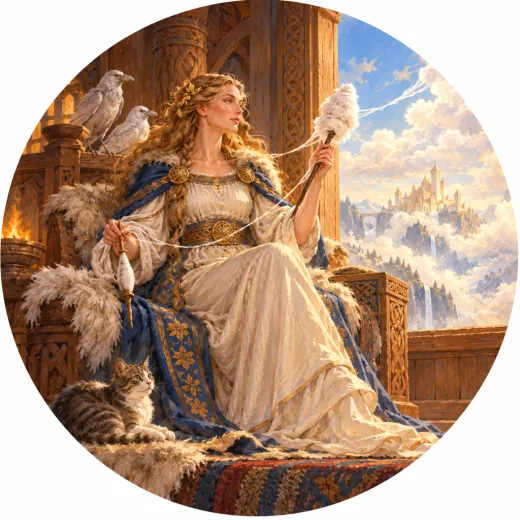
Frigg
Frigg, in Old Norse
not scary at all
Frigg is Odin's wife and the queen of the gods. She knows everything that will happen, but she tells no one. Her most famous story is about her son Baldr: when he began to dream of his own death, Frigg travelled the world and made every single thing promise not to harm him, from fire and water to stones, animals and plants. Only from one little plant did she not ask an oath, because it seemed too young to her: the mistletoe.
Did you know? According to Snorri, her servants include Hlín and Fulla, who wait on her.
The story
Frigg knew everyone's fate, and she never told a single one.
When people asked her what was going to happen, Frigg would gaze far away, in a direction where there was nothing at all, and talk about something else. She had a hall called Fensalir, the house of the marshes. Close to her were two handmaids: Fulla, who carried her shoes and her little casket and knew her secrets, and Hlín, to whom Frigg entrusted the people she wanted kept safe.
Her most beloved son was Baldr. He was the most beautiful of all, but that wasn't it. It was that when he walked into a room, the room seemed bigger.
One morning Baldr found her sitting at the window, and he sat down on the floor at her feet, the way he used to when he was little.
“Mother, I've been having dreams.”
Frigg did not move.
“Bad ones?”
“Heavy ones. They seemed to be about my life. I can't explain it any better than that.”
She ran a hand through his hair. And in that moment, perhaps, she saw something. Or perhaps not. Nobody ever knew.
When the gods met in council and decided that Baldr had to be protected from every danger, Frigg was the first to stand up.
“I'll do it.”
She set off that very day. She began with fire, and fire swore, its flames burning low, never to harm him. Then came water, which stood still in the river for a moment and promised. Then iron and all the metals, which said yes with a sound like bells. The stones. The earth. The trees, one by one, and their leaves went still in the wind. The sicknesses, which swore to pass him by. The beasts, the birds, the poison, the serpents.
It took her a long time. With every oath, Frigg felt her chest grow lighter. Everything in the world, she thought, now owes him a promise.
She went back to Fensalir with tired feet and a peaceful heart.
The next day, at the assembly, the gods discovered a game. Baldr would stand in the middle of the circle, and the others would throw things at him. Some shot arrows, some hurled stones, some struck with an axe or a sword. Everything, as soon as it brushed against him, stopped and fell to the ground. Baldr smiled, his arms spread wide. The gods laughed like children, and throwing things at Baldr seemed to them almost an honour.
Only Loki was not laughing.
Disguised as an old woman, with a walking stick and a scarf over her head, Loki turned up at Fensalir. Frigg welcomed her, because you welcome whoever knocks.
“Do you know what the gods are doing down at the assembly?” asked Frigg, full of that good mood that lingers for a while after a great effort.
“They're throwing things at Baldr,” the old woman replied. “All of them. Nothing hurts him.”
“Of course not. Neither weapons nor trees can harm him. I made everything swear.”
The woman was quiet for a moment. The stick tapped softly on the floor.
“Has everything really sworn?”
Frigg had no reason to suspect anything. She was simply tired, and proud.
“There's a young shoot west of Valhalla,” she said. “It's called mistletoe. It seemed too young to ask for an oath.”
The old woman nodded.
“A young shoot,” she repeated. “Quite right. It wouldn't hurt anyone.”
Then she got up, thanked her for her hospitality and left, and her stick made no sound at all.
Frigg stayed at the window. For a while the distant voices of the assembly reached her, the cheering, the laughter. Then those voices began to thin out. One last laugh broke off halfway. Then nothing.
There is no silence like that one. It is not the silence of the night, which holds the breathing of people asleep. It is a silence that has only just fallen, that still weighs heavy, and that has a hole in the middle the shape of a person.
Hlín came running, out of breath, her hair loose.
“My lady.”
“I know,” said Frigg.
She had known it for a moment, or perhaps for ever.
Baldr was dead. A blind god, Höðr, had thrown a sprig of mistletoe, guided by a hand that was not his own. The shoot, the one too small to be asked, had flown across the circle. The gods watched him fall, and nobody could find their voice.
Frigg did not weep straight away. She went down to the assembly, walking tall, and looked at her son lying on the ground. Then she turned to the others.
“Which of you,” she said, “wants to win my love and my gratitude for ever? Who will ride to Hel, to find Baldr and offer a ransom?”
It was Hermóðr, another of Odin's sons, who said yes. He set off the next day on Sleipnir, his father's horse, and Frigg watched him go until there was nothing left to see.
Then she began to wait. Nine nights he rode just to get there. At last Hermóðr came back, his horse flecked with foam, and told them what he had found: Baldr sitting in the place of honour in Hel's hall, with his wife Nanna beside him. Hel had said she would let him go, but on one condition only: that everything in the world, alive and dead, should weep for him.
“It will weep,” said Frigg. “The whole world loved him.”
Hermóðr had brought gifts, too. Baldr sent a ring to Odin. Nanna sent Frigg a robe of linen, and a gold ring to Fulla. Frigg held that cloth in her hands for a long time, as if it still carried a little of the warmth of the one who had touched it.
The gods sent messengers all over the world. And the whole world wept: people, beasts, the earth, the stones, the trees and the metals, just as you see everything do when it comes out of the frost into the warmth and starts to drip. Frigg listened to that weeping rising from every side, and for the first time in many days she began to hope.
In a cave the messengers found a giantess named Þökk. They asked her to weep. She answered: “With dry tears I will weep for Baldr's pyre. Let Hel keep what she has.”
Just one. In the whole world, just one thing had refused.
Frigg went back to Fensalir, and there, at last, she wept.
She wept for a long time, and not only for Baldr. Frigg knew the fates, and she knew this would not be her last sorrow: there would be another, when Odin, her husband, would walk out of his hall for the last battle, against the wolf, at the end of the world.
Nobody had told her. And she, as always, told no one.
Relatives around the world
Listen / Read next
- Music to read by: Cinematic JourneyEpic film-style music, no lyrics, by Ciro Simone IrmiciSpotifyYouTube Music
Sources
- Snorri Sturluson, Prose Edda, Gylfaginning
