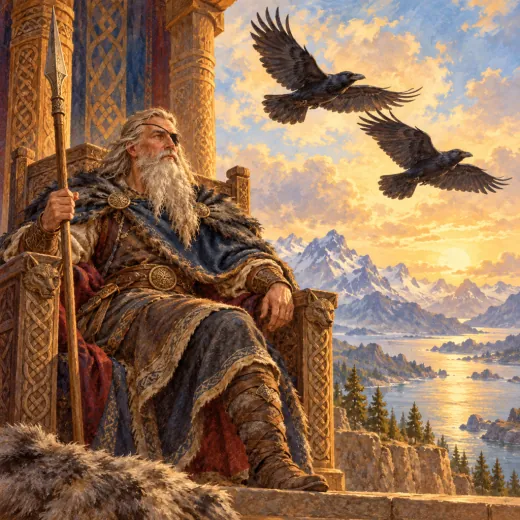
Huginn and Muninn
“Thought” and “Memory”, in Old Norse
not scary at all
Huginn and Muninn are the two ravens of the god Odin, and their names mean “Thought” and “Memory”. Every morning Odin sends them flying over the whole world; by breakfast time they return, perch on his shoulders and whisper into his ears everything they have seen. In this way the king of the gods always knows what is going on, even in the farthest places. In an old poem Odin admits he is afraid that one day they will not come back, and that he fears more for Memory than for Thought.
Did you know? The Vikings carried banners with a raven into battle: the Anglo-Saxon Chronicle records one being captured in 878.
The story
Every morning, before the first smoke rose from the chimneys of the world, two black ravens waited on the shoulders of an old man.
The old man was Odin. He sat on a high seat, a throne called Hliðskjálf, and from there he could see all the worlds: the sky, the sea, the mountains of the giants, the homes of humans. He had only one eye. He had left the other as a pledge, long ago, at the bottom of a well, in exchange for a single drink of wisdom. With the eye he had left he saw more than anyone else, and still it was not enough for him.
At his feet slept two wolves, Geri and Freki, and he fed them with his own hands everything that was served to him at table. He did not eat. Wine was all he needed.
But the ravens were his real strength.
Their names were Huginn and Muninn. The first meant Thought, the second Memory. Huginn was thinner, with narrow wings and a flight as straight as an arrow. Muninn was heavier, slower, and never set off without looking back.
“Go,” Odin said, every morning. He said nothing else.
The two ravens spread their wings and dropped down through the clouds, and Asgard grew small beneath them.
They flew over the whole world. They crossed the grey sea, where a ship was battling a wave as tall as a house and the sailors clung to the ropes with gritted teeth. They passed over forests of fir trees so thick they looked like a single sleeping animal. They skimmed the turf roofs of the farms, as women came out to throw out the water and children chased the hens. They saw a fisherman hauling in his nets. A woman standing still before a grave, her head bowed. Two men quarrelling over a boundary, and two others hugging for the same reason.
Higher up, where the air grew thin, they flew over the mountains of the giants, where no human had ever climbed and the snow did not melt even in summer. Down there, something moved in the caves. The ravens saw it, and remembered it.
Huginn looked at everything just once, and his mind snapped shut like a trap. Then he flew on, already thinking about what came next.
Muninn, though, would stop. He landed on a branch, on a stone, on the edge of a roof, and stayed there watching until every single thing had sunk all the way into his head. The fisherman, the ship, the woman at the grave. What had been, what had always been, what lay beneath what things seemed to be. Then he took off again, heavily, and struggled to catch up.
At mealtime, they came back.
They landed on Odin’s shoulders, one on the right and one on the left, and leaned in to his ear. No one else could hear. That was why the king of the gods always knew what was happening in the world, even in the most distant places. That was why, the poets said, he was called the raven god.
Then, one morning, something happened.
It was a day without wind, with a low, white light. The ravens set off as usual, and Odin watched them disappear, sitting on his throne with his hands on his knees. At noon the gods sat down to eat. The hall of Valhalla was full of the clatter of dishes and the sound of voices.
Huginn came back first. As always. He landed on the left shoulder, shook his wings and spoke softly into the old man’s ear, and Odin listened without moving a muscle of his face.
But the right shoulder stayed empty.
Odin said nothing. He did not get up, he did not call anyone, he did not send others to look. He waited while the wine was poured and drunk, while the other gods stopped talking, while the wolves stretched out under the table. The light in the hall changed, turned yellow, then red. Outside in the courtyard the wind had started blowing again, and from far below came the cry of a seabird. The gods left one by one. Some glanced at him, then quickly looked away.
The king of the gods was left alone, facing the darkening sky.
He thought of something he had once said, on an evening like this one, in words that humans still remembered. He had said: I fear that Huginn may not come back, but I fear even more for Muninn.
He had never explained it to anyone. But deep down he knew why. A thought goes and another comes: the mind always has new ones. Memory does not. When a memory is lost, what was inside it can never be made again. Even someone who sees all the worlds, and who left an eye in a well to know more, cannot put back together what he has forgotten.
The sky went out. The stars began to appear. Huginn stayed still on his shoulder, head tucked into his feathers, keeping him company.
Then, very high up, there was a wingbeat.
It was a heavy, slow wingbeat, like that of someone who has flown too far and still has a stretch of the way to go. Odin raised his head. A black shape was spiralling down in the last of the light, exhausted, its wings almost brushing the rafters.
Muninn landed on the right shoulder, and for a moment he could not even close his beak. Odin stroked his feathers, once, gently. The raven leaned towards his ear and said something, for a long time, in the faintest voice.
It was something Odin had forgotten so long ago that he did not even remember having forgotten it.
He told no one, that evening. The next day the two ravens set off as usual, and as usual he watched them disappear.
And even today, they say, when you see a lone raven in a winter field, perched on a stone, watching without hurry, as if thinking about something very far away, it may not be just any raven. It might be remembering for someone else.
Relatives around the world
Listen / Read next
- Music to read by: Cinematic JourneyEpic film-style music, no lyrics, by Ciro Simone IrmiciSpotifyYouTube Music
Sources
- Poetic Edda, Grímnismál, stanza 20
- Snorri Sturluson, Prose Edda, Gylfaginning
