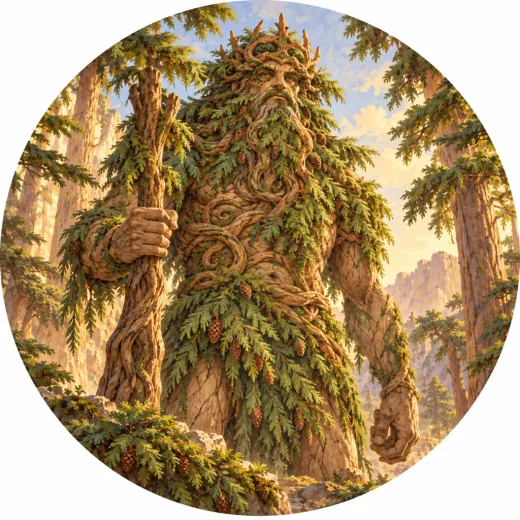
Humbaba
Huwawa in Sumerian
scary
Humbaba was the gigantic guardian of the Cedar Forest, placed there by the god Enlil to protect the trees. His face was made of twisting lines like an animal's insides, his roar was like a flood and his breath like fire. Gilgamesh and Enkidu went into the forest to defeat him and cut down the tallest cedars. With the help of the sun god, who sent the winds to hold him back, they succeeded. But the gods were not pleased with that deed, and the two friends paid dearly for it.
Did you know? Archaeologists have found many clay masks with Humbaba's face: they were hung up as charms against evil.
The story
No one ever went into the Cedar Forest.
Those who had come near its edge said that at a certain point the trees stopped moving, even in the wind. That the birds did not sing. That the silence was so heavy you could feel it on your shoulders, and that out of that silence, now and then, came a voice. It was not a human voice. It sounded like water when a dam gives way.
It was the voice of Humbaba.
The god Enlil had put him there to guard the cedars and to frighten people away. His roar was like a flood. His breath was fire, and it was said that breathing it was enough to kill you. He had a face that no one could describe properly, because it seemed to be made of tangled lines, like the coiled insides of an animal, and anyone who saw it never wanted to look at it again.
In Uruk, a young king wanted to go and face him.
“I'm afraid of dying,” Gilgamesh told Enkidu, his brother and companion, “but I'm more afraid of leaving no name behind. I want to cut down those cedars. I want people to say that I went where no one else would go.”
Enkidu lowered his eyes. He knew the forest. As a boy, when he lived among the animals, he had seen its edge. “It is no place for humans,” he said. “Humbaba has the hearing of a god. He never sleeps. Why do you need to fight him?”
But Gilgamesh had already made up his mind.
When the elders of the city heard, they came to beg him to give it up. “You are young, and your heart carries you too far. You don't know what is waiting for you. Let Enkidu go first, he knows the way. May the sun god protect you.” Gilgamesh's mother, Ninsun, climbed onto the roof of the temple, burned incense and spoke to the sun: “Why did you give my son such a restless heart? If he goes all that way, protect him.” Then she took Enkidu as a second son and embraced him.
They set off with heavy axes and swords, and with armour. They walked for days. Every evening Gilgamesh fell asleep at the foot of a hill and dreamed: a mountain falling on him, a snorting bull, a thunderstorm. Every morning Enkidu told him they were good signs, and Gilgamesh believed him, even though his heart was pounding.
Then they arrived.
In front of them, the forest was a wall of green and black. The cedars were so tall you could not see their tops, and beneath them the ground was dark and soft and thick with needles. There was not a single sound. Not even their footsteps: the earth swallowed them.
Enkidu stopped at the gate. It was a real gate, made of ancient wood. He reached out to push it, and his hand froze. It would not move any more. It was cold and dead, like somebody else's arm.
“Brother,” he whispered. “I can't.”
Gilgamesh took Enkidu's hand in both of his. “There are two of us. A boat on its own can sink, but two threads twisted together don't break.” He said it in a steadier voice than he felt inside. They went in.
They walked through the silence for a long time. Gilgamesh held his axe in both hands and spun round at every creak, even when it was only a branch settling. Enkidu never turned round: he looked straight ahead, as if he had already seen what was waiting for them. They stopped to look at the path that led to the guardian's home: it was wide and smooth, worn by his footsteps. High above, among the branches, the green of the cedars was so thick that day looked like evening. The air smelled of resin and of something burnt.
Suddenly the ground shook.
Humbaba appeared between the trees. He was enormous, and the sound of his steps made the leaves fall. He stared at the two men with eyes like a well. When he roared, the cedars bent like grass. Gilgamesh felt the breath go out of him. Enkidu's face was grey.
Then Gilgamesh raised his eyes to the sky and shouted: “Shamash, god of the sun! I walked all this way because you told me to. Help me!”
Shamash heard him. From the sky came the winds: the south wind, the north wind, the storm, the icy wind, and many others, from every side. They struck Humbaba all at once. The guardian could no longer move forward or back. Pinned down and trembling, he raised his hands.
“Gilgamesh,” he said, and for the first time his voice was the voice of a small creature. “Forgive me. Let me live. I did not choose to be here: Enlil put me here. You can take as many cedars as you like. I will be your servant.”
Gilgamesh hesitated. His heart was shaken by a sudden pity. “Enkidu,” he said softly, “perhaps we should let him go. A prisoner has no strength left.”
“Don't listen to him,” Enkidu replied. “Humbaba is speaking with the mouth of someone who is afraid. If you let him live, he will come after you. And sooner or later Enlil will find out everything. Do it now.”
Humbaba understood. He raised his face and cursed them with his last words: that Enkidu would not have a long life, that he would not grow old, that he would not have a good end. Then he spoke no more.
The heroes hesitated no longer. There was a single blow, and when it was all over the forest seemed to sigh. Then the silence fell back among the trees, heavier than before.
They cut down the tallest cedars. From the finest they made a great cedar door for the temple of Enlil, and carried it down the Euphrates on a raft, with the guardian's head as proof.
Enlil saw them coming from far away. When he understood what had happened, his anger was terrible. “Why did you do this? You should have treated him with respect. He was the keeper of the cedars, and now the forest has no one.”
Gilgamesh did not answer. For the first time in his life, he did not feel like a winner.
In the forest, the wind passed among the smaller cedars and found no one there. Many years later, in the houses of Mesopotamia, people hung clay masks by their doors, with that face of tangled lines: by then the guardian kept evil away.
Relatives around the world
In the trails
Listen / Read next
- Music to read by: Cinematic JourneyEpic film-style music, no lyrics, by Ciro Simone IrmiciSpotifyYouTube Music
Sources
- Epic of Gilgamesh, Tablets II–V
