The Leprechaun
leipreachán, in Irish
not scary at all
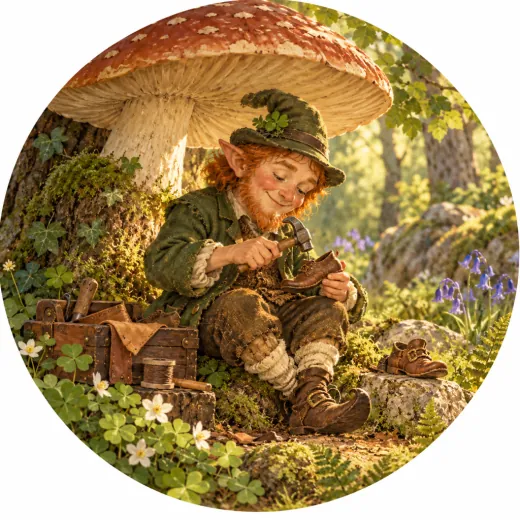
The leprechaun is a solitary Irish fairy, as small as a little child, who works as a shoemaker: if you hear a tiny hammer tapping in the woods, perhaps he is busy with a shoe. Somewhere he has hidden a pot full of gold coins. If you manage to catch him and never take your eyes off him, he has to tell you where the treasure is. But he is extremely sly: one moment of distraction and he vanishes. In the nineteenth-century collections he is often dressed in red; green came later.
Did you know? The name “leprechaun” comes from “luchorpán”, the three small beings who, in an ancient Irish tale, drag King Fergus out toward the sea as he sleeps on a beach.
The story
The oldest tale that mentions leprechauns has no gold in it and no rainbows.
An Irish king called Fergus had fallen asleep on the seashore, and three tiny little beings grabbed him by the feet and tried to drag him into the water. Fergus woke up, seized all three of them and held them tight in his hands. “Let us go,” they said. “We'll give you anything you want.” Being a king with plenty of common sense, he chose to be able to swim under water like a fish. They said yes, with just one warning: never in one particular lake. Naturally, that is exactly where Fergus went, and that is another story.
Since then the little beings have had time to learn their trade. And the story they told around the fire in Ireland, a thousand years later, went like this.
One summer evening, a farmer was coming home from the fields with his hoe over his shoulder. He had stopped by a hedge to catch his breath when he heard a noise.
Tap, tap, tap, tap.
A little hammer. Tiny, but very determined, coming from right behind the branches.
The farmer knew that sound. His grandfather had told him about it, and his grandfather's grandfather had told him. He knelt down and, holding his breath, pushed a twig aside.
Sitting on a stone was a little man no taller than a four-year-old child, with a face as wrinkled as an old apple. He wore a pointed hat, a red jacket with big buttons and a leather apron, and he was carefully tapping at the sole of a shoe. A single shoe. Beside him on the grass stood a jug filled to the brim with something that smelled of beer.
The farmer wasted no time. With one leap he stretched out his hand and grabbed him by the collar.
“Ah!” said the little man, without dropping his hammer. “I see you got out of bed on the right side this morning.”
“You're a leprechaun,” said the farmer. “And I'm not letting go of you until you tell me where you keep your gold.”
“Gold?” The little man opened his eyes wide, looking as innocent as anyone in the world. “What gold? I'm a poor shoemaker. Look at these hands. They're full of holes from the needle.”
“I know all about you,” said the farmer. “As long as I don't take my eyes off you, you have to tell me.”
The little man sighed. The farmer was right, and they both knew it.
First, though, he tried every trick he had. “Look,” he said in a worried voice, “your cow has got into the oats. If she eats the lot, you'll have no field left tomorrow.” The farmer didn't turn his head. “Look, there's an enormous hawk above you!” The farmer didn't look up. “Your shirt's on fire!” The farmer, who had heard that story far too many times, simply tightened his grip on the collar a little. In the end the fairy saw it was no use, and gave in.
Then came the most important moment of the whole tale: the moment when the farmer had to do one thing and one thing only. Look. No blinking, no scratching, not looking away for even a second.
“There,” said the little man with a sigh, pointing with his chin. “My gold is under that yellow plant, over there, in the middle of the field. Dig and you'll find it.”
The farmer looked at the field. A yellow plant, yes, but there were dozens of them, knee-high, all alike and all in flower. “Which one?” he asked. “I told you: the one in the middle.” “The middle of what?” “Of the field, obviously. What a question.” The little man pretended to be offended, his nose in the air, dangling his feet in mid-air like a child sitting on his grandfather's lap.
“Don't move,” said the farmer. And without letting go of the little man, he carried him in his arms right to the middle of the field.
“There,” said the little man. “This one. This very one.”
The farmer stopped. He had no spade and no hoe with him: he had left the hoe leaning against the hedge. He couldn't let go of the little man to fetch it. But he didn't want to dig with his bare hands either.
He had an idea. He took his red handkerchief from around his neck, the finest one he owned, and tied it round the stem of the plant, good and tight, with three knots.
“Swear,” he said. “Swear you won't take it off.”
“I swear,” said the little man. “On my shoe.”
The farmer let him go, because a promise made by a leprechaun holds, and ran to fetch his hoe. He was back in a few minutes, out of breath, sweat on his forehead and his face red with satisfaction.
He stopped, and the hoe slipped out of his hand.
The field was full of red handkerchiefs.
There was one on every yellow plant, dozens and dozens, all alike, every stem tied tight with three knots, every one perfect. The wind stirred them gently, like lots of little flags. In the middle of the field, the setting sun made that sea of red glow.
From somewhere behind the hedge came a thin little giggle.
“I kept my promise!” shouted a tiny voice. “I didn't take it off! I never took it off! I just put some more on!”
The farmer stood in the middle of the handkerchiefs, speechless. Then, slowly, he began to laugh too. It was a real laugh, one that came from deep down and made his belly ache. There was nothing to be done: he had been beaten, and beaten well.
At home that evening, he told his wife everything.
“You've lost your handkerchief,” she said. “And all the others too, if the little man keeps them. Did you at least find anything useful?”
“No,” said the farmer. “Only a good story.”
But the next morning, when he opened the door, he found his left shoe on the doorstep, the one with the hole he had been putting up with for a month. It had just been resoled, with a sole so neatly stitched it looked brand new. The right shoe was where he had left it, with its hole, just as before.
For a while he thought it was a kindness, and for a while he thought it was a joke at his expense. In the end he decided they were the same thing.
Because a leprechaun never gives away two shoes.
But now and then he leaves one on the doorstep for someone who knows how to lose with a laugh.
Relatives around the world
Listen / Read next
- Music to read by: Cinematic JourneyEpic film-style music, no lyrics, by Ciro Simone IrmiciSpotifyYouTube Music
Sources
- Echtra Fergus mac Léti, The Adventure of Fergus (8th century)
- W. B. Yeats, Fairy and Folk Tales of the Irish Peasantry (1888)
