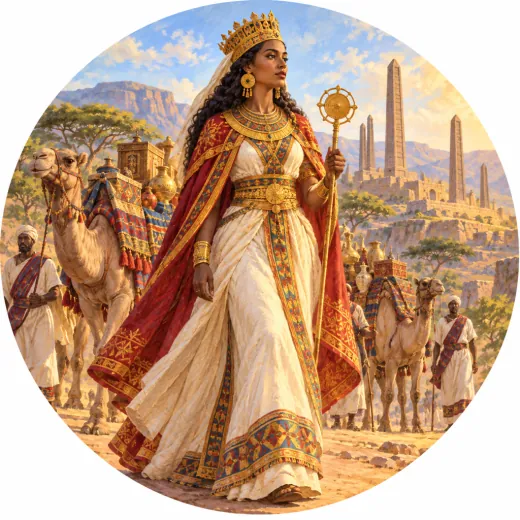
The Queen of Sheba
Makeda, in the Ethiopian tradition
not scary at all
The Bible tells that the Queen of Sheba travelled to Jerusalem with a caravan of camels loaded with gold and spices, to test King Solomon with very hard questions. In Ethiopia this story became much more: the queen is called Makeda, and the son born to her and Solomon, Menelik, founded the dynasty of the Ethiopian kings. According to the book Kebra Nagast, Menelik brought the Ark of the Covenant to Aksum. For the Ethiopian Orthodox Church this is a living and sacred tradition.
Did you know? The emperors of Ethiopia, down to the last one, Haile Selassie, deposed in 1974, claimed descent from Menelik.
The story
Before dawn, in the desert, a long line of camels set off.
They were loaded to bursting. Sacks of fragrant spices that smelt of resin and scorched earth. Baskets of gold. Chests of precious stones. At the front, on a camel taller than the rest, sat a woman. Her face was covered in dust and her eyes were fixed on the north.
She was the Queen of Sheba, and she was going to put a king to the test.
She had heard about Solomon. All over the earth people said there was nobody as wise as he was, that he could answer anything, that he had built a house for God and a palace for himself. The queen was a woman used to being obeyed, and to not believing rumours. “I'll see it with my own eyes,” she had said. “And I'll ask him some questions.”
The journey was long. Days of sand, of wind, of thirst, of cold nights when the camels huddled down side by side. Then the land began to turn greener, villages appeared, and at last, on top of a hill, the walls of Jerusalem.
The Bible tells what happened next in few words, and tells it well. It says the queen arrived with a very great retinue, and that she spoke with Solomon about everything that was in her heart. Her questions were hard, it says, but it does not write down what they were. There was not one of them, it adds, that Solomon could not answer.
The queen looked at everything. She looked at the palace, the king's table, the servants standing in their ranks, the cupbearers in their fine new robes, the offerings the king brought to the temple. At a certain point, the text says, there was no breath left in her.
“I heard about you in my own country,” she told the king. “I did not believe what they said until I came and saw for myself. But they had not told me even half of it.”
She gave him gold in great quantity, and spices, and precious stones. The Bible says spices like those never came to Jerusalem again. Solomon, in turn, gave her everything she desired. Then the queen went back to her own country.
Here, in the Bible, the story ends.
But in Ethiopia, on the other side of the sea and the desert, people tell the rest.
In the book called the Kebra Nagast, “the Glory of the Kings”, written in Ge'ez, the old language of Ethiopia, in the 14th century, the queen has a name: Makeda. She reigns at Aksum, in a land of mountains and great stones, and one day one of her merchants, back from Jerusalem, tells her what he has seen: a just king, a splendid temple, a God whom the people of Israel honour with a reverence like no other.
Makeda sets off. It is months on the road. When she reaches Solomon, she asks him to explain his law to her, and he does, and she listens carefully. At the end she says, “From now on I will no longer worship the sun. I will worship the Creator of the sun, the God of Israel.”
Before her departure, the queen and the king make a promise. She asks not to be touched against her will; he asks that she take nothing from his house. One night, Solomon has a banquet served of very salty, spicy food, and has a jar of water placed beside the queen's bed. In the middle of the night she is terribly thirsty. She gets up and drinks. And Solomon, who has been watching from a distance, tells her, “You have taken water from my house. The promise is broken.”
Before she leaves, Solomon gives her a ring: if a son is born, he says, the boy can show it, and Solomon will know him. The queen sets out for Aksum. On the journey, a son is born.
Later they call him Menelik. He grows up in his mother's house, like a king from the time he is a boy. And when he is about twenty, he says, “I want to see my father.” Makeda hesitates. Then she lets him go.
In Jerusalem he shows the ring his father had given his mother, and Solomon recognises it. Besides, the boy looks like him. He welcomes him as a son, and wants him to stay as his heir. Menelik wants to go back to Ethiopia. The king, reluctantly, agrees, and sends him off with a group of young men, the sons of the nobles of Israel, to go with him.
It is on this journey home that the greatest thing happens. In the Kebra Nagast, one of the young men, Azariah, secretly carries off the Ark of the Covenant, the chest holding Moses' commandments, leaving an identical copy in Jerusalem. When Menelik finds out, already on the road, he faces a choice nobody would want to make. He does not turn back. He says, in the story, that it is the will of God. From that moment the journey is so swift it seems like flying.
The Ark reaches Aksum. Menelik becomes king. And from him, according to Ethiopian tradition, all the rulers of the country descend, in a line that reaches the 20th century. The last emperor, Haile Selassie, deposed in 1974, declared himself one of his descendants.
For the Ethiopian Orthodox Church this is not a fairy tale but a sacred story. At Aksum, next to the church of St Mary of Zion, there is a small chapel where the Ark is said to be kept. A single monk looks after it, spending his whole life there, never allowed to leave. Nobody else may enter. So nobody else can say they have seen it.
Faced with a story like this, historians do what historians do: they say there is no proof, that the Kebra Nagast was written many centuries after the events it tells, and that a dynasty needs a grand origin. Those who believe reply that true stories cannot always be proven with documents. Each side has its reasons, and neither is foolish.
But think of the desert, in the morning, and the camels. Of a woman with her face covered in dust crossing half the world to ask a man a question. That part, at least, is in the Bible. And every people that has told it has added a piece of itself.
A living tradition, told with respect: how we tell myths.
Relatives around the world
Listen / Read next
- Music to read by: Cinematic JourneyEpic film-style music, no lyrics, by Ciro Simone IrmiciSpotifyYouTube Music
Sources
- Kebra Nagast (14th century)
- The Bible, First Book of Kings, chapter 10
