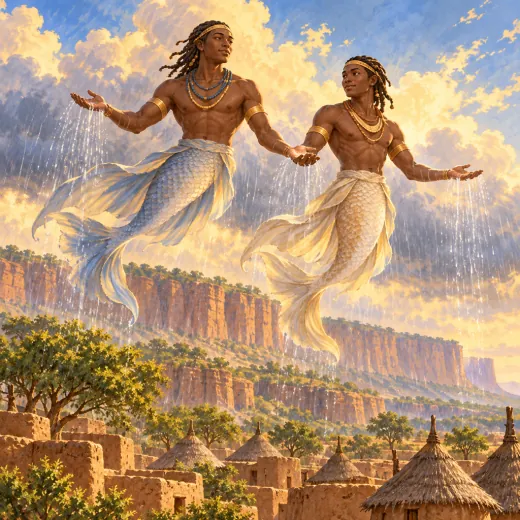
The Nommo
Nommo, in the Dogon language
not scary at all
The Dogon live in Mali, in villages built along the Bandiagara Escarpment. In the accounts collected by the French ethnologist Marcel Griaule, the creator god Amma brought forth the Nommo, twin spirits linked to water, with a changeable form: sometimes half human and half fish, sometimes like serpents. They were the ones who brought people speech, rain and the rules for living together. More recent studies, however, have shown that some things Griaule wrote cannot be found in the stories told today: scholars' books also need to be read with care.
Did you know? It was long said that the Dogon had known for centuries about a small star near Sirius, but an anthropologist who lived with them found no such knowledge.
The story
Before there was earth, before water and stars, there was only Amma.
That is how the story of the world begins for the Dogon, a people of Mali who live along the great Bandiagara Escarpment, where the mud villages look like nests stuck to the rock. And that is how a French ethnologist, Marcel Griaule, heard it told in the autumn of 1946.
The man who told him was an old hunter who had gone blind, Ogotemmêli. For thirty-three days the stranger and the old man sat in the shade of a shelter, and every day the old man added another piece.
“If you want to know how the world is made,” he said once, “you must accept that it takes a long time to tell.”
This was the first piece.
Amma was alone. Before him there was nothing: no space, no time, no sound. And yet everything was already inside him, the way a tree is already inside a seed. When the hour came, Amma made the earth and stretched it out like a body lying down, its face turned to the sky. Then he wanted to fill it with life, and so he made the Nommo.
The Nommo were twins, always in pairs, a male and a female, because for the Dogon whatever is complete has two halves. They were made of water. Not just the water you drink: all water, rain, rivers, the water inside a newborn baby and inside a sprouting seed. In Griaule's books they have the upper body of a person, skin as green as still water, red eyes; from the waist down their bodies are long and winding, like a fish or a snake. They hardly ever walked. They swam through water, through air, through the inside of things.
But not everything went the way Amma had planned.
One of the beings born from him, Ogo, the Pale Fox, could not wait. He was impatient. He wanted to make a world of his own, right now, before its time and without his twin half. He broke away from the order of things and leapt into the void, and what he dragged with him became a dry, crooked, empty land. Ogo was left alone, searching for something that was no longer there.
And so disorder came into the world. For the Dogon, disorder is a real thing, like thirst or cold, and words alone cannot cure it.
Then Amma made a hard decision. He chose one of the Nommo and offered him as a sacrifice. His body was divided into parts, and the parts were scattered towards the four corners of the horizon, the way seed is scattered. Wherever a piece fell, something went back to its proper place.
Then Amma gathered the parts, joined them together, and with his breath gave the Nommo back his life.
The one who returned was not the same. He had passed through death, and that was why he could guide the others. Amma sent him down to earth.
From here, Ogotemmêli's story becomes almost a travel diary.
The Nommo came down from the sky in an ark: a great square granary with a stepped roof, swaying as it fell through the void. With him were eight ancestors, four couples, the first men and the first women of the Dogon. There were the animals, each in a pair, and the plants, hidden inside their seeds. And there was a smith, the first smith, carrying a little fire and a hammer.
When the ark was close to the earth, the smith struck his anvil. The sound was the first thunder. Below them lay the hard red earth that Ogo had left in disorder, without a puddle, without a blade of grass.
The ark touched the ground. And the Nommo, who was water, brought the water.
For the first time, it rained. The drops beat on the red earth, and the earth drank, and drank again, and the smell that rose up was the smell of every beginning of the rainy season, the one the Dogon wait for each year with their necks stretched towards the sky.
“Can you smell it?” said the old man. “That smell is as old as the world.”
The people had climbed out of the ark and stood there in silence, seeds in their hands. They did not yet know how to speak properly. They had breath, tongues and teeth, but not speech. Again it was the Nommo who taught them, with something very familiar to the Dogon: weaving.
As the loom clacked, tick, tack, tick, tack, the thread went back and forth, in and out, and the language of the Nommo passed into their fingers and then into their mouths. That is why, they say, a cloth is like a sentence: it has a thread that begins and a thread that ends, and in between there is the pattern. Whoever weaves is speaking, and whoever speaks is weaving.
So people learned to call each other by name, to say “mine” and “yours”, to make promises, to sing. They learned to sow near the water. They learned to tell when work is right and when it is too much, and to remember that disorder has never quite gone away: it waits in a corner, like the Pale Fox, for someone to stop paying attention.
Ogotemmêli finished his story on the thirty-third day. The sun was low, and from the cliff rose the noise of children coming back from the well.
Griaule wrote it all down, and in 1948 he made it into a book, Dieu d'eau, “God of Water”. The book was a huge success and made the Nommo famous all over the world.
But books, even the best ones, must be read with care. After him, another scholar, Walter van Beek, lived among the Dogon for a long time and did not find, in today's villages, everything Griaule had written. Some ideas were not well known, others were known only to a few elders, others had perhaps changed. What has stayed still and what has moved, the Dogon know better than any professor.
The story remains what a blind old man entrusted to a stranger, one evening, under a shelter: the tale of a god who made water, and of a water that came down from the sky and taught people to speak.
And when the first rain arrives on the escarpment, it is worth standing quietly for a moment, face lifted, to hear what it is saying.
A living tradition, told with respect: how we tell myths.
Relatives around the world
Listen / Read next
- Music to read by: Cinematic JourneyEpic film-style music, no lyrics, by Ciro Simone IrmiciSpotifyYouTube Music
Sources
- Marcel Griaule, Dieu d'eau (1948)
- Walter E. A. van Beek, Dogon Restudied, Current Anthropology (1991)
