Kibuka
Kibuuka, in Luganda
a little scary
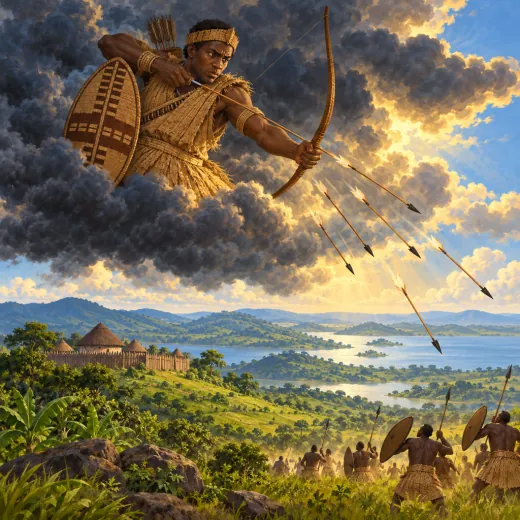
Kibuka was a warrior spirit of the Baganda, the people of the kingdom of Buganda, in Uganda. Tradition tells that he was sent to help the king in a hard war: Kibuka flew over the battlefield hidden in a cloud, and from up there struck the enemy with his arrows. There was a rule about women prisoners of war, but a Baganda warrior broke it and kept a captured woman with him, who discovered Kibuka's secret and revealed it. The enemy shot their arrows into the cloud, and Kibuka was wounded: in the best-known version he died of the wound, in others he vanished for ever.
Did you know? The sacred objects of his shrine ended up in an English museum in the early twentieth century; in 1962, when Uganda became independent, they were returned to Kampala.
The story
No one in the king's army had ever seen a cloud stand still.
Clouds pass by, fray apart, go wherever the wind takes them. Not this one. It hung over the battlefield, low and dark, even when the wind changed, and now and then an arrow came out of its belly.
It was the time of the war between the kingdom of Buganda and the kingdom of Bunyoro, and the king of the Baganda, the kabaka Nakibinge, was losing it. The enemy had more men. Every day more wounded came back from the front, and every evening the camp grew quieter.
So the king asked the gods for help.
He turned to Mukasa, the great god of the lake, who ruled over the islands in the water and gave rain and harvests. Mukasa listened. He did not come himself. He sent his brother Kibuka, a warrior, whom from that day on the people called the god of war.
Kibuka arrived with a small band of followers. He carried no shields and no spears. He had a bow, he had arrows, and he had something no other soldier owned: the sky.
On the first morning he fought, the Baganda saw a cloud form above the enemy lines. There was no wind. It was not the season for rain. And yet the cloud came down, stopped, and from its edges arrows began to fly, sure and steady, one after another, in no hurry.
The men of Bunyoro looked up. Then they raised their shields, which were no use, because the arrows came from above. Their front line wavered. They could not understand who was striking them, and what you cannot understand is more frightening than any army.
That evening Kibuka came down to his own camp. He sat with the king and said only a few words.
“Tomorrow I begin again. And I ask you one thing only. Bring no women prisoners into the camp until the war is over.”
“Why?” someone asked.
“Because whatever is brought into the camp sees what is in the camp,” Kibuka replied. “And I do not want to be seen.”
For days it went on like that. At dawn the cloud rose, at midday it came down on the enemy, in the evening it settled again. The Baganda took heart, and little by little they began to push forward. Kibuka's arrows never missed.
In the camp of the Banyoro, meanwhile, people talked in low voices. Some said it was a spirit of the Baganda. Others said the sky had turned against them. An old warrior who had seen many battles said nothing: he watched the cloud in the evening, when it settled, and counted the days.
The Baganda had learned to recognise the sound. Before an arrow came, high up, there was a faint rustle, like leaves. The men would glance at each other and smile. It was the sign that Kibuka was at his post.
But in an army, one man is enough.
One day a Baganda warrior had captured a woman from Bunyoro. She was young and frightened, and he did not have the heart to leave her at the edge of the camp. He kept her with him, in his hut, and told no one. He told himself it did no harm, that she was only a woman, that the rule was meant for soldiers, not for her.
The woman did not speak. She watched.
In the evening she saw the warrior come back from the meeting with the king. She saw that some men, in one corner of the camp, bowed before a hut that was quieter than the others. She saw that at dawn, before the camp woke, someone came out of that hut, walked to an open place and, all of a sudden, was not there any more. Then a cloud appeared in the sky.
She was not stupid. She put the pieces together the way you put a basket together: one strand after another.
She remembered what she had been taught as a child: that other people's secrets are never safe when there is someone with time to watch. She thought too of her home, of her brothers on the battlefield, of the arrows coming from the sky and of how many, over there, would never come back. Her hands were shaking. She was not sure she was doing right. She only knew she had no other choice.
One night, while the warrior slept, she left. She crossed the bush in the dark, her heart pounding, and reached her own people's lines. And she told them what she had seen.
The commander of Bunyoro heard her out to the end, without interrupting. Then he gave an order, in a low voice.
The next morning the enemy archers no longer watched the horizon. They watched the cloud. They waited for it to come down. They waited until it was low, almost on top of them. Then, all together, they shot.
There was a sharp sound, like a flock of birds rising from the grass.
The cloud stayed still for a moment, as if it were listening. Then it trembled. The Baganda heard a voice, just one, coming from above, and it was not a cry of rage. Then the cloud moved. Slowly, like a wounded animal, it drifted away towards the lake.
Some men ran to follow it. Others stood frozen, faces turned upwards. Soon the sky was empty again, a blue that seemed to be laughing at them.
What happened to Kibuka, the traditions do not all tell in the same way. In the most widespread version, the one Roscoe collected, he died of the wound and his followers gathered what was left of him. In others, wounded, he withdrew to the place he had come from and never again fought in the world of men. But they all end the same way: the secret that protected him had been revealed by someone nobody had taken seriously.
His name was not forgotten. The Baganda built a shrine for him, and his priests guarded its sacred objects for generations. Centuries later, at the beginning of the twentieth century, some of those objects left for a museum in England. In 1962, when Uganda became independent, they came back to Kampala.
So the cloud, in this story, is not just a cloud. If one evening the sky closes over the lake and everything goes quiet, you find yourself looking up and waiting to see whether a cloud, high above, stays still.
A living tradition, told with respect: how we tell myths.
Relatives around the world
Listen / Read next
- Music to read by: Cinematic JourneyEpic film-style music, no lyrics, by Ciro Simone IrmiciSpotifyYouTube Music
Sources
- John Roscoe, The Baganda, Macmillan (1911)
- Museum of Archaeology and Anthropology, University of Cambridge, records of the Kibuka relics
