Shango
Ṣàngó, in Yoruba
a little scary
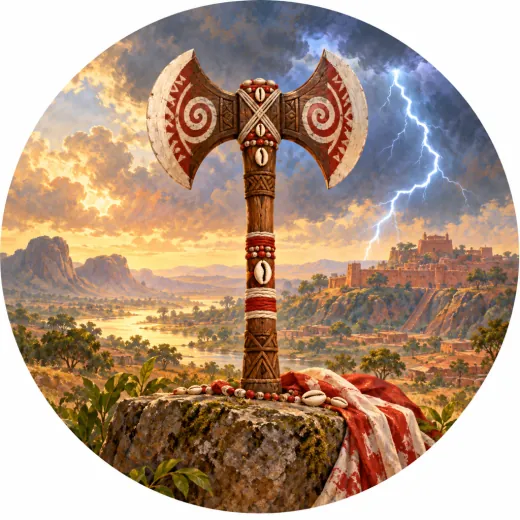
Shango is the orisha of thunder, lightning and justice, still revered today in West Africa and the Americas. Tradition also remembers him as a king of the city of Oyo, strong, brave and fiery-tempered, who breathed fire when he spoke. His symbol is a double-headed axe, and his colours are red and white. It is said that he punishes liars and thieves with lightning. He is also the lord of dance and drums.
Did you know? The bàtá drums, played in his honour, are famous for their powerful sound and are still used in Cuba and Nigeria.
The story
Anyone who has seen a storm in West Africa knows: it comes all at once. First the air goes still, and the leaves stop moving. Then the sky turns black at midday, the wind changes direction and all the hens run for shelter, and the people of Oyo know what is about to happen. They know who is coming. And even if they are afraid, they do not say it with fear. They say it with respect.
“Shango is passing,” they say.
Before he was the lord of thunder, they say, Shango was a king.
He reigned in Oyo, a city of high walls and noisy markets. He was one of the sons of Oranyan, the founder, and he was the strongest king the city had ever had. Tall, fiery, very handsome, with braided hair and eyes that flashed with challenge. No horse could resist him. No rival could meet his gaze for more than a moment.
His temper was made of flames. When he was angry, his voice made the walls shake. And people said that when he spoke in anger, sparks and smoke came out of his mouth, as from a blacksmith's furnace. At such moments his courtiers stared at their feet.
He loved music. When the drums played in his courtyard he danced for hours, and his body moved with the same energy as his stride in battle. But most of all he loved power. And that is why, one day, he decided to learn a secret.
It was a secret hidden in certain roots and certain words: a medicine for calling down lightning.
The old men of the court knew about it, and they tried to talk him out of it. “Lightning obeys no one,” they said. “Whoever calls it must then bear it.” Shango listened to them with a half-smile, and the next day he went back to his experiments.
For months, in secret, Shango studied it. Every time he thought he had understood it, he went up onto the roof of the palace and tried it out. A cloud would gather, a roll of thunder would grumble far away. The king would smile. He felt as great as the sky.
It was on a sweltering evening, one of those when the air is so heavy it feels like breathing wool, that Shango attempted the greatest test of all. He climbed onto the roof, raised his arms and spoke the words.
The sky split in two.
A blinding white light came down out of the darkness and struck the palace. The roof caught fire. Screams rang out across the courtyard. When the noise died away, Shango was standing there, motionless, and all around him the palace was burning. In the fire, some of his family had been lost.
It was not an enemy that struck him. It was his own power.
For a long time the king did not speak. Then, little by little, grief took the place of shock. He had wanted the lightning so that he could feel greater, and the lightning had taken from him what he held most dear.
Oya, his wife, came up to him, unafraid. “It was nobody's fault,” she told him quietly. “You wanted to know how far the sky reaches.”
“And now I know,” he answered.
That night he left Oyo. He no longer wished to rule, and he did not turn round to look at the walls. A few loyal followers went with him, and among them was his wife Oya, who did not abandon him. They walked for days, towards the region where, people say, Shango's mother came from, in the land of the Tapa. The road wound down through ever thicker forests. The silence was so deep that you could hear every footstep.
Meanwhile, in Oyo, people struggled to put out the fire and wondered what had become of their king. No one could give them an answer.
The further they went, the fewer the followers became. One by one, tired and frightened, they turned back. Only a few were left. Then almost no one.
They came to a place called Koso.
Here, according to Johnson, the king took his own life beneath a tree. But his faithful do not accept it. When someone in the city repeated that rumour, there were those who answered: Oba koso. “The king did not hang himself.” And they told a different story: that Shango did not truly come to an end in the forest, but that his body vanished in a blaze of light, that the king rose into the sky, and that thunder is his voice.
Oya vanished too. They say she became the river the Yoruba call Odo Oya, the Niger. But that is another story.
In Oyo, meanwhile, something began to change.
After he disappeared, the sky filled with storms. Lightning struck houses, burned granaries, split trees. People trembled. Some said: “It is Shango, taking his revenge because we abandoned him.” Others answered: “No, he has left us something. Whoever honours him will be protected.”
That is why many people went to the priests and brought gifts for the god. After the storms, farmers began to find certain dark, smooth stones in the fields, shaped like axe heads. They said these had been hurled from the sky. Today we know they are ancient stone axes, polished by people who lived thousands of years earlier. The farmers took them to the priests, who kept them with great care. They are called edun ara, the thunderstones.
And so the worship began. And so the dance began. Shango's name travelled from village to village, beyond the borders of Oyo, and went where all things Yoruba go: far away, carried on the feet of their own people.
Shango's devotees dress in red and white, red for fire and white for light. In their hands they carry his double-bladed axe, the oshe. They dance to the rhythm of the bàtá drums, great hourglass-shaped drums that speak like voices. The rhythm builds, slow and powerful, and those watching feel their chests throb.
And they say his judgement is just. Whoever lies to do harm, whoever steals from the poor, whoever forgets respect knows that the sky can answer.
Even today in Nigeria, when a storm comes, people do not just take cover. They stand for a moment in the doorway, watching the first flash of lightning. And in a low voice, they say his name.
“Shango,” they say. “Go on by. We are here.”
A living tradition, told with respect: how we tell myths.
Relatives around the world
In the trails
Listen / Read next
- Music to read by: Cinematic JourneyEpic film-style music, no lyrics, by Ciro Simone IrmiciSpotifyYouTube Music
Sources
- Samuel Johnson, The History of the Yorubas (1921)
- Pierre Verger, Orixás (1981)
