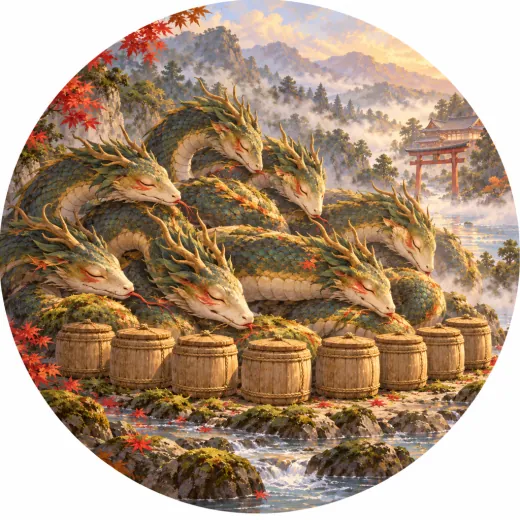
Yamata no Orochi
八岐大蛇, the eight-headed serpent
scary
Yamata no Orochi was a serpent so huge that its body stretched over eight valleys and eight hills, with eight heads, eight tails and eyes as red as the akakagachi, the fruit we call the Chinese lantern or winter cherry. Moss and trees grew on its back. To defeat it, Susanoo had eight barrels of very strong sake prepared and placed them behind a fence with eight openings. The serpent put one head into each barrel, drank everything and fell asleep. Then Susanoo defeated it with his sword.
Did you know? In the Izumo region this story is still performed in traditional kagura dances, with extremely long cloth serpents.
The story
There is one day a year when, in the valley of the river Hi, the birds stop singing.
It happens quietly. First a great tit that does not answer, then the wind dropping, then the frogs falling silent all at once, as if someone had shut a door. The river keeps flowing, but without a sound. The air smells of moss and wet earth. And on the hills in the distance, the cedars and cypresses start to sway, even though there is no wind.
The farmers in the valley know that day. They shut their doors, put out their lanterns, and do not look outside.
In a house near the river lived an old man and an old woman, Ashinazuchi and Tenazuchi. They had had eight daughters. Every year, on that day, a serpent with eight heads came from the land of Koshi. Every year it took one of them away.
Seven times they had waited for it. Seven times they had tried to hide their daughter: under the floor, in the hayloft, in a faraway field. The serpent always knew where to look. On the table in that house there were seven cups too many, and nobody had the heart to clear them away.
Now only one daughter was left. Her name was Kushinadahime, and that evening she sat in a corner, no longer crying, because she had run out of tears.
It was at that moment that someone knocked.
It was a young man in untidy clothes, with the look of someone who has travelled alone for too long. He had followed the wooden chopsticks that the river had carried down to him. He introduced himself as the brother of Amaterasu, the sun, and said he had recently come down from heaven. His name was Susanoo.
He listened to the story without interrupting. Then he looked at the girl.
“Give her to me. I will save her.”
Once the old couple had said yes, he wasted no time. With a single gesture he turned the girl into a comb and slipped it into his hair, to keep her safe. Then they set to work. They needed a very strong sake, brewed eight times, until it was almost like fire. They needed a fence with eight gates, and behind each gate a platform, and on each platform a brimming vat.
They worked for hours in silence. At last the fence was ready, and the sake filled the air with a sweet, heavy smell.
Then there was nothing to do but wait.
The old man and the old woman sat in a corner by the lamp, huddled together. They did not dare look up. Susanoo, hidden behind the fence with his sword in his hand, could feel the comb resting in his hair against his neck: a small wooden thing that every now and then seemed to tremble. Outside, the night was growing longer than usual. It felt as if time itself were waiting with them.
And suddenly, silence.
A tremor in the ground, like a footstep too big to be a footstep. In the undergrowth at the top of the hill, a branch snapped with a crack. Then another. The cedars bent over, all together, as if before a wind that was not there.
The serpent came down.
It was a single body, but as long as eight valleys and eight hills. It had eight heads and eight tails. On its back grew moss, cypresses and cedars, like a mountain that had stood up and started to walk. Each of its sixteen eyes was red as a winter fruit, red as an ember in the fog. Wherever it passed, stones rolled down the slope.
It stopped in front of the fence.
The eight heads rose up, side by side, and sniffed. Their thin tongues tasted the air. For an endless moment, nobody in the valley breathed.
Then the heads caught the smell of the sake.
Each head looked for its gate. Each one found its vat. There was a deep, round, liquid sound: the serpent was drinking. It drank with all its heads, without stopping, and the valley filled with the noise of eight throats swallowing. The red eyes grew slow. One head swayed and leant against the edge of its platform. Then another. Then another.
Susanoo was hidden behind the fence. He was counting.
Six heads on the ground. Seven. One was still up, awake, its eyes glowing, looking around. Slowly it turned its neck towards the spot where Susanoo was hiding. It stopped. It sniffed.
Susanoo did not breathe.
The head stayed like that for what felt like a whole night. Then it too, little by little, began to sway, to sink, to fold down on top of the others. A slow, deep breathing filled the valley: the breathing of a sleeping monster.
Then Susanoo leapt out with his long sword.
The blade came down, and down again. The river Hi, which had seen seven daughters vanish, turned red all the way to the sea. The serpent did not have time to raise even one head.
But when he reached the middle tail, the sword struck something very hard and chipped. Puzzled, Susanoo opened the tail with the tip of his blade, and inside he found a sword more beautiful than any other, gleaming like water. The text calls it Kusanagi. It had been hidden in the darkest part of the monster, like a seed in a rotten fruit.
Then the comb became a girl again.
Kushinadahime came out of Susanoo's hair, looked at the valley, looked at the serpent's motionless body, looked at her parents running towards her. Nobody said anything. There was only a long hug, beside a river that had turned red.
The next morning, when the sun came up behind the hills, a great tit sang.
It was the first time in seven years that a bird had been heard on that day.
Even today, in the region of Izumo, the story is told through dance: with very long cloth serpents and eight heads popping out from the back of the stage. The children watching scream, and laugh, and scream again. Then the dance ends, the serpent falls, and everyone applauds.
By then, nobody is afraid any more.
But when the wind drops and the birds stop singing, the old people still lower their voices.
A living tradition, told with respect: how we tell myths.
Relatives around the world
In the trails
Listen / Read next
- Music to read by: Cinematic JourneyEpic film-style music, no lyrics, by Ciro Simone IrmiciSpotifyYouTube Music
Sources
- Kojiki (712)
- Nihon Shoki (720)
