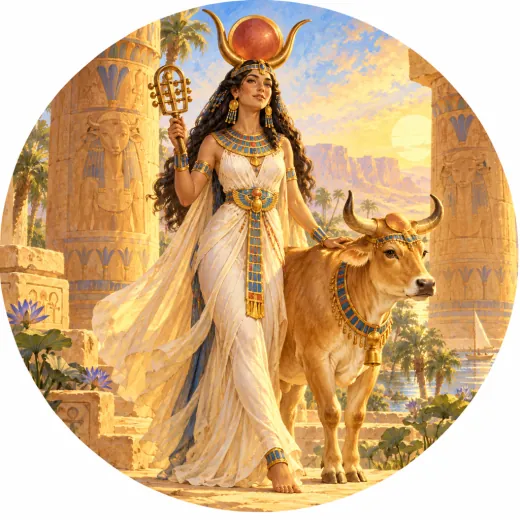
Hathor
Ḥwt-Ḥr, “house of Horus”
not scary at all
Hathor was the goddess of love, music, dance and joy. She was shown as a cow, or as a woman with cow's horns and the sun disc between them. Her festivals were full of songs and sounds: musicians shook the sistrum, an instrument that jingled like a rattle. She protected women, mothers and also the miners who dug for turquoise in the Sinai desert, where she was called “lady of turquoise”. Her most beautiful temple is at Dendera.
Did you know? In 1821 a large stone zodiac was removed from the ceiling of the temple at Dendera: it is now in the Louvre in Paris.
The story
In Dendera, on the day the new year began, you heard the temple before you saw it.
It was a jingling. Hundreds of sistrums shaken together: wooden handles with a frame and little metal rods that rattled, and the sound was like fine rain on a bronze roof. Underneath the jingling were drums, flutes, hands clapping the rhythm, and the voices of women and children singing the same song with different words.
It was the festival of Hathor.
The columns of the temple bore her face: a woman’s face, calm, with cow’s ears, carved high up on the stones. Inside, the goddess waited in the half-light, as a woman with cow’s horns and the sun disc between them, and as a real cow, who feeds the king with her milk and gives her warmth to the world. She was the goddess of love and joy, and she protected women, mothers and little children.
In the front row that day stood a woman with a little girl. She was shaking her sistrum with a care that was not like the others’. Someone was missing from her home.
Her son had left in the spring. He was fourteen and had a gentle nature, and they had not wanted to let him go. But the team was setting out for the Sinai desert, to the turquoise mines, and a nimble boy who could get down into narrow spaces was worth more than a grown man. Thirty of them had set off, with donkeys loaded with bread, onions and waterskins, and they had followed the river and then the desert road, day after day, to a land of rocks where water had to be carried on your back. Since then there had been no news.
The woman said nothing. But every evening she shook her sistrum in the room, as if the music could reach all the way out there.
In Sinai, the boy had not heard it that evening. But something had reached him.
Where he worked, the world was made of yellow rock and sunlight. Nothing grew, there was not a single bird, and the wind from the north filled your mouth with sand. By day the mountain burned, by night it froze. The boy crawled down into a narrow tunnel with a fat lamp and a stone hammer, and felt along the walls for the streak the bosses called mefkat: turquoise, the stone the colour of water seen far off. Down there time did not pass: you worked until the lamp went out, and then you groped your way back up towards a circle of light.
He had not found any yet. After four months his companions had brought up grey stones, worthless rocks, and the foreman, a thin old man with a crooked leg, had started to say nothing at all.
That morning the boy felt ill. The dust had filled his chest, and the tunnel seemed narrower than usual. He went out into the air and sat on the ground with his head between his knees.
The old man sat down beside him.
“Are you scared?” he asked.
“Yes.”
“So was I, the first few years.” The old man looked up at the sky. “Come, I’ll show you something.”
At the top of the ridge, where the wind whistled, there was a small stone sanctuary, with a courtyard and some stelae, and inside it the figure of a woman with cow’s horns. It was an ancient place. On the stone, scratched by people who had passed before them, there were names, and prayers, and one sign that was always the same: the sign for turquoise.
“This is her house,” said the old man. “Here we call her the Lady of Turquoise. Out in the desert, there’s no one else who looks after us.”
From a leather bag he took out a small sistrum, old, with one bent rod, and shook it once, gently.
The sound was tiny in the vastness of the desert. But suddenly it seemed to the boy that the wind was no longer just wind. He thought of his mother, and of a jingling he remembered from when he was little, and his eyes filled with tears.
“Sing something,” said the old man.
“I don’t know the words.”
“Nobody does. Make them up.”
The boy sang. Out of tune, and quietly. He sang about his home, the river, the roof, a cat he was fond of. The old man tapped the beat with his foot, and the sistrum jingled, and little by little the boy’s chest felt wider. When they stopped, they were both laughing without knowing why.
They left a small grey pebble on the altar, which was all they had.
The next day the boy went back down the tunnel. He was no longer looking for anything; he just felt along the wall as he hummed. Under the fingers of his left hand he felt a smooth, cold vein, different from the rock. He brought the lamp closer.
It shone. It was green and blue at once, like the Nile seen from a boat.
He shouted so loudly that his companions outside thought the roof had caved in.
The team came home at the beginning of summer, their bags full, and in Dendera there was a small celebration for them. The boy was thinner, burned by the sun, with a new way of looking around him. His mother looked at him for a long time before she said a single word.
Then she put her hands to her eyes, and laughed and cried at the same time.
“Did you play?” he asked later, when his mother’s eyes were dry.
“Every evening.”
“I sang.”
Neither of them wanted to know who had heard whom.
The following year, on the day of Hathor’s festival, among the hundreds of women shaking sistrums in Dendera, there was one with a bead around her neck. A small bead, blue and green like faraway water. She played loudly and out of tune, and beside her a boy, who no longer sang under his breath, tapped the beat with his foot.
High up on the columns, the goddess watched them all with her peaceful face and her cow’s ears. They say she never missed a note.
Relatives around the world
Listen / Read next
- Music to read by: Cinematic JourneyEpic film-style music, no lyrics, by Ciro Simone IrmiciSpotifyYouTube Music
Sources
- Book of the Heavenly Cow, tombs in the Valley of the Kings
- Geraldine Pinch, Egyptian Mythology, Oxford University Press (2004)
