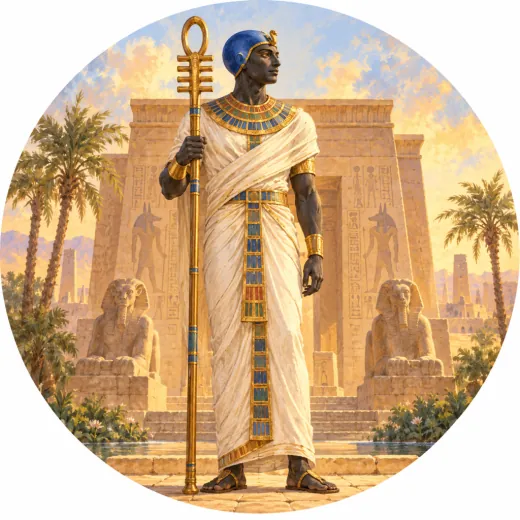
Ptah
Ptḥ, in Egyptian
not scary at all
Ptah was the great god of Memphis, the ancient capital of Egypt, protector of craftsmen, sculptors and architects. He was shown as a man wrapped in a tight cloak, with a skullcap on his head and a sceptre in his hands. In Memphis people said that he had created the world in a very special way: first he thought of everything in his heart, then he spoke it with his tongue, and whatever he said came to life. In the Shabaka Stone, an ancient inscription, even the other gods are born from his heart and his tongue.
Did you know? Many scholars think the name “Egypt” comes from Hut-ka-Ptah, “the house of the spirit of Ptah”, his great temple in Memphis.
The story
When King Shabaka arrived in Memphis, about seven hundred and ten years before the birth of Christ, nobody had told him that in the temple of Ptah there was a treasure that was eating itself away.
Shabaka was a king who had come from the South, from Nubia, and he ruled Egypt. He wanted to see with his own eyes the oldest city of all, great Memphis, with its white walls and its temples full of statues. In the streets the same sound could be heard everywhere: hammers, chisels, saws, the clang of smiths and the thump of potters. Memphis was the city of people who worked with their hands. The oldest priest led him into the house of Ptah and, after a long staircase, into a low, cool room where the papyrus scrolls were kept.
“There is a work of the ancients here,” said the old man. “They say it is the most important in the temple. Nobody reads it any more.”
The king took the scroll in both hands. It was as dry as an autumn leaf. He opened it with his fingers, with endless care, and one corner of the papyrus crumbled. He saw rows of fine, orderly signs, and then he saw holes. Tiny, round, hundreds of them. Worms had eaten whole words.
“Since when?” he asked.
“For a long time. Nobody can say since when.”
Shabaka stayed silent. He understood what it meant. A work of the ancestors cannot be put in a corner and left to disappear. If the word dies, what it says dies with it.
“Copy it,” he ordered. “Again. On stone, so that it lasts.”
A block of black stone was chosen, tall and heavy. The old priest read the text aloud, piece by piece, and the scribe wrote it down, sometimes filling the gaps from memory. In some places, where the worms had eaten too much, there was nothing but empty space, and the scribe, unsure, left it that way.
“And these holes?” the king asked one evening, coming by to check. “Can’t they be filled?”
“With what, Majesty?” the old man replied. “If we make things up, it will no longer be their voice, but ours. Better an honest gap than a false word.”
The king nodded, and asked nothing more.
After the scribe, a stonemason worked on the stone.
He was a young man with hands marked by dust, and he could not read everything he carved. He followed the signs drawn by the scribe with his chisel, one by one, holding his breath, the way you do when you carry a full glass. But one evening the old priest stopped behind him to watch, and began to read aloud what was taking shape.
“Ptah was the greatest,” he said. “Before anything existed, there was him. And he wanted to make the world.”
The stonemason looked up. He knew Ptah well: it was his statue in the temple. A man wrapped in a cloak as tight as a mummy’s, with a cap on his head and a sceptre in his hand, and an expression as calm as water without wind. But he had never heard how Ptah had made the world.
“He didn’t make it with his hands,” the old man went on. “He didn’t carve it or shape it. He thought.”
“He thought?”
“In his heart. Because for the Egyptians thought did not live in the head, it lived in the heart. Ptah thought of every thing: the sky, the earth, the rivers, the gods, the name of every thing. It was all there, inside, still and silent, like a statue still trapped inside the rock. But a thought shut up in the heart exists for no one. So Ptah used his tongue.”
“And he spoke.”
“And he spoke. Every word that came out of his mouth was a thing being born. He named the gods, and the gods appeared. He named the cities, and the cities rose out of the ground. The nine oldest gods, the text says, are the teeth and lips of that mouth, which gave every thing its name. Horus was the heart. Thoth was the tongue. And the eyes see, and the ears hear, and the nose breathes, but everything that reaches them they carry to the heart, and the heart decides, and the tongue says it.”
The stonemason looked at the chisel in his hand. He thought of how many times he had looked at a block of stone and already seen inside it the shape of a bull, or of a king, waiting. First in his head, then in his hand. He knew it was not the same thing, but it seemed close.
“And when he had finished?” he asked.
“He rested,” said the old man. “That is what the text says. Ptah rested, because everything was made, and because everything that had been said pleased him.”
The young man went back to work, more slowly. The signs looked different to him now. Every line cut into the stone was a word the worms would never get.
The stonemason finished the last line in spring. On that black stone were all the words that could be saved, and where the papyrus had been too damaged, the stone was left full of gaps, like a mouth that has lost its teeth. The king came to see it. He ran his hand over the surface, along the cold lines, without saying anything.
Then the centuries passed. The stone was moved, forgotten, and at some point someone used it as a millstone for grinding grain, and the turning of the millstone wore away some of the words. But not all of them. What is left can still be read in a museum in London.
And Memphis, the city of Ptah, had another name, which the Greeks heard and twisted: Hut-ka-Ptah, the house of the spirit of Ptah. Many scholars say that from that sound, passing from language to language, came the name of the whole land: Egypt.
Ptah, they say, had created the world by saying it. A king and a stonemason, with a block of black stone, had tried to do the same thing on a small scale: to save some words, because as long as someone reads them, they still exist.
Relatives around the world
Listen / Read next
- Music to read by: Cinematic JourneyEpic film-style music, no lyrics, by Ciro Simone IrmiciSpotifyYouTube Music
Sources
- Shabaka Stone, British Museum (about 710 BC)
- Miriam Lichtheim, Ancient Egyptian Literature, vol. I, University of California Press (1973)
