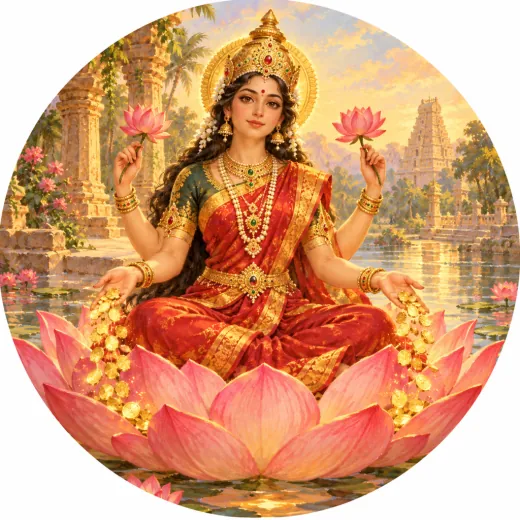
Lakshmi
Lakṣmī, in Sanskrit
not scary at all
Lakshmi is the goddess of prosperity, good fortune and beauty, revered all over India. Tradition tells that she was born again when the gods and their rivals churned the ocean of milk together to obtain the nectar of immortality: from the waves rose Lakshmi, seated on a lotus flower. She is the consort of Vishnu, and when he comes down to earth she goes with him in another form, for example as Sita beside Rama. She is shown with four arms, lotus flowers and gold coins falling from her hands.
Did you know? During Diwali, the festival of lights, many families draw a rangoli in front of the door, a design made of coloured powders, to welcome Lakshmi.
The story
Long ago, in Indra's heaven, there was an age of plenty.
The gods knew no hunger. They knew no cold. The kingdom of Indra, lord of the sky and of thunderstorms, bloomed with gardens, and from his court a fragrance of wealth and peace drifted out into every world. This was because, in those days, Shri lived among them.
Shri is one of the names of Lakshmi: the goddess of good fortune, of prosperity, of beauty. Wherever she dwells, harvests are good, homes are in order and people have enough to live on. Long ago she had been born to the wife of the sage Bhrigu, and she had always been the companion of the god Vishnu.
One day, the sage Durvasa was walking through the world.
He was a stern sage, the kind who never lets a slight go by. A maiden of heaven gave him a garland of fragrant flowers. Durvasa took it to Indra's heaven and offered it to him.
Indra accepted it and placed it on the neck of the elephant he rode, Airavata, the white elephant of the great gods. But the elephant did not understand. It smelled the scent, lifted the garland with its trunk and threw it to the ground, trampling it.
Durvasa's face turned red.
“You have scorned my gift,” he said to Indra. “A gift given by a sage, and you treated it like a scrap of cloth. For your pride, the wealth of the three worlds will leave you.”
And so it was.
That night, Shri went away. She left the heavens, the earth and the regions below, and withdrew into the ocean of milk, to a place no one could reach. In Indra's hall the lamps dimmed by themselves, one after another, and the flowers in their vases bowed their heads. Indra noticed, and understood too late what he had lost. The next day, the three worlds began to wither. The harvests yielded little. Homes emptied. The gods themselves, who had once shone with strength, grew weak. And their rivals, the asuras, noticed.
They attacked. They won. The defeated gods fled to the highest mountain and turned to Brahma, the creator, who led them to Vishnu.
Vishnu listened in silence. Then he spoke in a calm voice.
“Make peace with the asuras for a time. Together, churn the ocean of milk. From it will come the nectar of immortality, and with it you will be strong again. But the task is great, and it cannot be done by one side alone.”
The gods and the asuras, enemies since the beginning, accepted the pact. It was the only way.
They took Mount Mandara as the stick to churn the ocean. They took Vasuki, the many-headed serpent, as the rope. The gods held the tail, the asuras the head. And Vishnu, to support the mountain, which would otherwise have sunk into the sea, took the form of an enormous tortoise and placed himself beneath it.
They began to pull.
The mountain turned, back and forth, back and forth, and the ocean of milk foamed beneath their efforts. The noise could be heard from one end of the universe to the other. Neither side stopped to rest. For hours, for days, for years. The gods sweated and the demons panted. Vasuki hissed. The white water rose in waves like mountains.
Then, out of the waves, gifts began to rise.
First a cow that granted every wish. Then a flowering tree whose fragrance filled the worlds. Then heavenly maidens, and the moon, pale and round. The gods watched and did not dare speak. Among the gifts there also appeared a man holding a cup: Dhanvantari, the physician of the gods, with the amrita, the nectar that gives immortality.
The asuras claimed everything that came out of the water, and the gods, who wanted no more quarrels, let them. But it was not over yet.
The sea grew still. The water parted like a curtain, and from the depths a flower rose. A great pink lotus. And seated on the lotus, holding another lotus in her hand, was a woman of a beauty no one had ever seen.
It was Shri. It was Lakshmi.
The gods fell silent. The sages who were present began to sing a hymn in her honour, softly, their voices trembling. The sacred rivers, Ganga and the others, came down to bathe her. The elephants of the four directions washed her, pouring water from golden jars. The ocean itself brought her a garland of lotus flowers that would never fade.
Lakshmi did not look at the gods. She did not look at the asuras, who were already reaching out their hands towards her. She looked at one place only.
Vishnu was looking back at her.
She went to him. She placed the garland around his neck. And she came to rest, lightly, upon his chest, where she would remain.
The asuras, who had fought so hard for her, understood that they had lost her. Without her, even the strongest of them had lost half their strength. The gods, on the other hand, felt their vigour return, as after a long illness. Indra's heaven bloomed again.
And Indra, who had learned his lesson, bowed before her and dedicated a hymn to her.
It is said that Lakshmi never leaves those who honour her with a sincere heart. She does not choose the rich, and she does not choose the powerful. She chooses the homes where people work honestly, where whoever knocks at the door is welcomed, where there is order and gratitude. And she withdraws, in silence, from places ruled by pride and greed.
When Vishnu comes down to earth to help humankind, she comes down with him. In the Ramayana she is Sita, the wife of Rama, who follows him into the forest and waits for him through the hardest days.
And still today, on the night of Diwali, the festival of lights, families light little lamps along their doorsteps. In front of the door they draw the rangoli, a carpet of coloured powders, in the shape of lotus flowers. And many leave the door open.
To light her way, if she wishes to come in.
A living tradition, told with respect: how we tell myths.
Relatives around the world
Listen / Read next
- Music to read by: Cinematic JourneyEpic film-style music, no lyrics, by Ciro Simone IrmiciSpotifyYouTube Music
Sources
- Vishnu Purana, Book I
- David Kinsley, Hindu Goddesses, University of California Press (1986)
