Pele
Pelehonuamea, in Hawaiian
a little scary
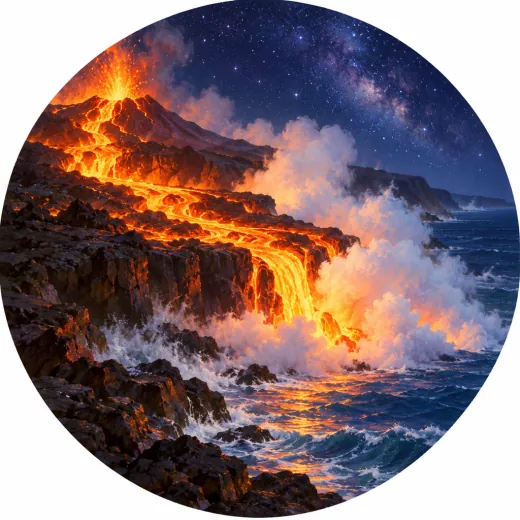
Pele is the goddess of volcanoes and fire of Hawaii, still revered today. Tradition tells that she came to Hawaii by canoe from a faraway land and looked for a place for her house of fire: every time she dug, her sister Nāmakaokahaʻi, goddess of the sea, put out her fire with water. In the end Pele found a home in the crater of Kīlauea, on the largest island. When the volcano erupts, Hawaiians say that Pele is creating new land.
Did you know? There are very fine threads of volcanic glass that the wind carries after eruptions: they are called “Pele's hair”.
The story
Before she was a goddess of the mountain, Pele was a traveller.
She came from a faraway land, which the islands call Kahiki, and one day she left it. She was not running from just any enemy. She was running from water. Because in the sea lived her elder sister, Nāmakaokahaʻi, the lady of the waves, and the two sisters no longer got along. Fire and water do not keep each other company for long.
Pele climbed into a great canoe, steered by her brother Kamohoaliʻi, who could read the currents better than anyone. With her were other brothers, and a tiny sister, Hiʻiaka, whom Pele carried under her arm wrapped in an egg, like a treasure. In her other hand she held Pāʻoa, her digging stick, with which she meant to dig herself a home.
They sailed for many days. The sea was vast and dark and full of stars. At night the canoe cut through water black as glass, and beneath the hull there was only the long breathing of the waves. Nobody spoke. Pele kept her eyes on the way ahead, never closing them, and the heat rising from her chest made the air around her smoke. One morning, on the horizon, a green line appeared.
It was Hawaii.
Pele landed on the first island and looked for a place. She made a hole in the rock with her stick, and fire came out of the hole. A red, living fire that rose towards the sky and lit up the coast. The goddess stood watching it, with a joy she had not felt for a long time. This was her home.
It did not last.
The next day the sea began to pull back, then returned with a wave so high you could not see the top of it. Nāmakaokahaʻi had arrived. The water poured into the pit, filled it and put it out with a hiss that could be heard for miles. Pele was left on the sand with empty hands.
“You chose badly,” said her sister from the waves. “The sea reaches everywhere.”
Pele did not answer. She picked up her stick and set off.
She moved on to the next island, Oʻahu, and started again. She dug another pit, deeper and wider, and the fire came out again, stronger than before. For a while the mountain glowed, and from the beach people would have seen a red dawn where no dawn should be. Then the waves came back. Again the hiss, again the smoke, again the cold sand. And the same on Molokaʻi. Wherever she went, her sister chased her. The stories say that with every new pit Pele left behind her a hill, a crater, a slope of black rock, and if you look closely, on those islands, you can still see them.
The goddess was tired. It was not a tiredness of the body, but a subtler kind: the tiredness of someone who starts again, and again, and again. At night, on the beach, she sat with little Hiʻiaka on her knees and listened to the sea talking in the dark. She said nothing, but the hand gripping her stick never opened.
At last she reached Maui, where there is a huge mountain called Haleakalā, the house of the sun. Here, they say, the battle took place. Pele fought with everything she had. The two sisters faced each other on the mountain: waves against lava, clouds of steam, the sky turning white. The fight was long and terrible, and in the end the sea sister won. Pele’s body broke like a clay pot, and her bones stayed there, on the mountain, as a reminder. On the summit, for a long moment, there was no sound at all: not the wind, not the sea, not the fire.
But a goddess does not truly die.
Her spirit, still full of fire, rose from the rock like a flame. It was taller than before. It looked south-east, to where the sea ended and another land began, the biggest of them all, young and still smoking, with mountains so high they touched the clouds. Pele spread wings of light and flew there.
On the island of Hawaiʻi, at the top of a mountain the sea could not reach, she found an enormous crater, deep as a valley, called Kīlauea. Inside it was a cavern of rock, which today is called Halemaʻumaʻu. Pele went in and down to the very bottom, where the rock was as warm as a hand. Her sister’s waves, however high, could not reach that far. For the first time after so much sea, the goddess could sit down and feel nothing behind her.
She stayed.
Ever since, her home has been there. At the bottom of the crater the lava moves slowly, red as a heart. Sometimes it rises, spills over and runs down the sides of the mountain in slow, glowing rivers, heading straight for the sea. When it meets the water it bursts into a cloud of steam, and her sister is there waiting for it. But every time the lava cools, where there was sea there is a new piece of land. The coast grows longer. The island gets a little bigger.
That is why, in Hawaii, they do not say that the volcano destroys. They say that Pele creates.
They also say that you must come near her with respect. People who climb Kīlauea often bring a small gift: some branches, a flower, a few red ʻōhelo berries, which Pele loves. They speak softly, they sing, they take nothing away. They do not do it out of fear. They do it because Pele is family: they call her Tūtū, grandmother. And with a grandmother, when she is made of fire, you mind your manners.
After eruptions, the wind lifts very fine threads of volcanic glass, long and golden, which get caught in the grass and on the branches of the trees. They are called Pele’s hair. If you find one at night near the crater, when the sky turns red and the smoke rises straight up, you can imagine it is her combing her hair, sitting on the edge of her home, watching the sea from far away.
She is no longer at war with her sister. They have found a way to live side by side: one here, one there. Where they touch, an island is born.
A living tradition, told with respect: how we tell myths.
Relatives around the world
Listen / Read next
- Music to read by: Cinematic JourneyEpic film-style music, no lyrics, by Ciro Simone IrmiciSpotifyYouTube Music
Sources
- Martha Beckwith, Hawaiian Mythology (1940)
- National Park Service, Hawaiʻi Volcanoes National Park, materials on Pele
