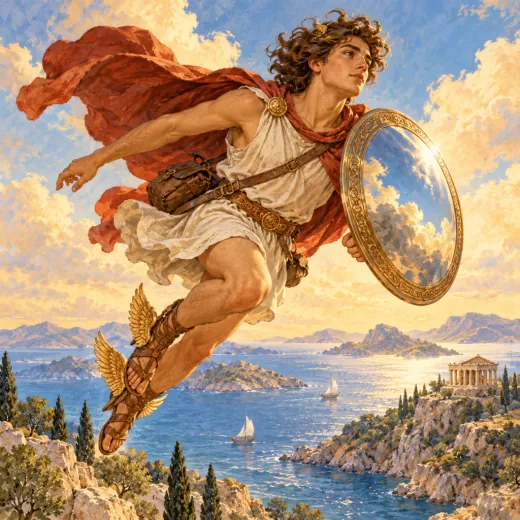
Perseus
Perseús, in Ancient Greek
a little scary
Perseus was the son of Zeus and the princess Danaë. A bullying king, wanting to be rid of him, sent him to fetch the head of the Gorgon Medusa, who turned to stone anyone who looked at her. Gods and nymphs helped him: he received winged sandals, a helmet that made him invisible and, from Athena, a shield as shiny as a mirror. Looking at Medusa only in the reflection, Perseus defeated her. On the way home he rescued the princess Andromeda, chained to a rock in front of a sea monster, and married her.
Did you know? The shooting stars of August seem to come from the constellation of Perseus: that is why they are called the Perseids.
The story
Even before he was born, Perseus had an enemy, and that enemy was his grandfather.
His name was Acrisius, he was king of Argos, and he had a daughter called Danaë. One day he went to consult the oracle, to find out whether he would have a son. The answer was a sentence of doom: “You will have no son. And your daughter's son will kill you.”
Acrisius never slept again. To stop what the oracle had said from coming true, he had a bronze chamber built beneath the palace, with no doors and only a single opening at the top, and he shut Danaë inside. No man would ever see her.
But Zeus saw her. He came down into that room as a shower of gold, which fell into the girl's lap. When Acrisius heard a newborn baby crying from below ground, he knew the oracle had not been wrong.
He didn't have the heart to kill his daughter and his grandson. Instead he shut them inside a big wooden chest and threw it into the sea.
The chest floated for days. Danaë held the baby close and sang to him softly in the dark, so that he wouldn't hear the waves. When at last the chest bumped against a shore, a fisherman called Dictys, on the island of Seriphos, pulled it in with his net. He took them into his home. Perseus grew up there, in a fisherman's hut, with the sun on his face and nets in his hands.
But even on the island there was no peace.
The king of Seriphos, Polydectes, was a bully, and he wanted to marry Danaë. She kept refusing him, and Perseus, a young man by now, always stood between them, like a shield. Polydectes decided to get him out of the way. He held a banquet where everyone had to bring the king a gift. Perseus, who had nothing to give, said a foolish, proud thing: “I'd even bring you the Gorgon's head.”
“Perfect,” said Polydectes, smiling. “Bring it to me.”
Perseus set off the next day, carrying his mother's sorrow with him. Athena and Hermes guided him. He found the Graeae, those old sisters who share a single eye between them. He found the nymphs, who gave him winged sandals, a bag and the helmet that makes its wearer invisible. Hermes handed him a sickle that could not break. Athena gave him a shield of bronze polished like a mirror.
Medusa's island was full of statues: men who had looked at her and never left again. Medusa was asleep. Perseus never once looked her in the face: he searched for her only in the reflection on the shield, and, with his hand guided by Athena, the sickle came down just once. From her neck, they say, a winged horse leapt out. Perseus put the head in the bag and flew away over the sea, with Medusa's sisters on his heels, for a whole day.
Now came the journey home, which was no shorter.
He was flying east, over a coast of black rocks, when Perseus heard something. A thin cry of grief, rising from a cliff above the sea. He flew lower, and he saw.
A girl was chained to the rock. Her arms were tied up above her, her hair loose over her shoulders, her eyes full of tears. Nobody around. Only the wind and, further down, the dark sea moving in a strange way.
“Who are you?” Perseus asked, landing beside her. “Who did this to you?”
Her name was Andromeda. She was the daughter of Cepheus, king of a faraway land, and of his wife Cassiopeia. One day her mother had boasted that she was more beautiful than the Nereids, the nymphs of the sea. Poseidon, offended, had sent a monster to lay waste to the coast. The oracle had said there was only one way to stop it: give it the king's daughter.
“My father wept,” said Andromeda. “But the people shouted. They brought me here.”
As she spoke, the water rippled. An immense shape rose out of the sea, as long as a ship. Perseus had no time to think. He leapt into the air on his winged sandals, and the monster snapped at him with its jaws. Perseus circled above it, fast, and every time he passed he struck with the sickle. The monster thrashed in the water, foaming, roaring. In the end it sank, wounded, and vanished beneath the waves.
Perseus freed Andromeda from her chains and took her back to her parents. But before handing her over, he asked for one thing: “I want her as my wife.”
Cepheus and Cassiopeia, who had been about to lose her, agreed at once.
It was a wonderful celebration, but it didn't last long. Halfway through the banquet, the doors burst open. In came Phineus, the king's brother, who had been promised Andromeda's hand before the monster came, with a band of armed men. He wanted her back.
A brawl broke out in the hall. Perseus was only one man, and his enemies were many, far too many. Then he remembered the bag. He shouted to his friends: “Close your eyes!” And he pulled out Medusa's head.
As if by magic, the uproar stopped. Phineus, with a look of surprise on his face, was left with his arm raised. All his men, each caught in the middle of whatever he was doing, turned to stone.
The silence in the hall was so deep you could hear the torches crackle.
Perseus stood still for a moment, then put the head away. He sought no further revenge. He took Andromeda and went back to Seriphos, where his mother was still waiting for him on the shore, searching the horizon.
He carried the head into Polydectes' hall, in the middle of a banquet. “You asked for a gift,” he said. “Here it is.” He closed his eyes and held it up. Polydectes and his courtiers stayed frozen for ever.
Then Perseus returned his gifts to those who had lent them. Medusa's head went to Athena.
Many years later, at an athletic contest, Perseus threw a discus. The discus flew off course and struck an old man in the crowd, who fell. It was Acrisius, who had come to watch the games without anyone knowing. The oracle had come true, without anyone meaning harm.
They say Perseus, Andromeda, Cassiopeia and Cepheus all ended up together in the sky, as four neighbouring constellations. And every August, a shower of shooting stars seems to come from the very constellation of Perseus: the Perseids. Sometimes, they say, it is the gold falling.
Relatives around the world
Listen / Read next
- Music to read by: Cinematic JourneyEpic film-style music, no lyrics, by Ciro Simone IrmiciSpotifyYouTube Music
Sources
- Ovid, Metamorphoses, Books IV and V
- Apollodorus, Library, Book II
