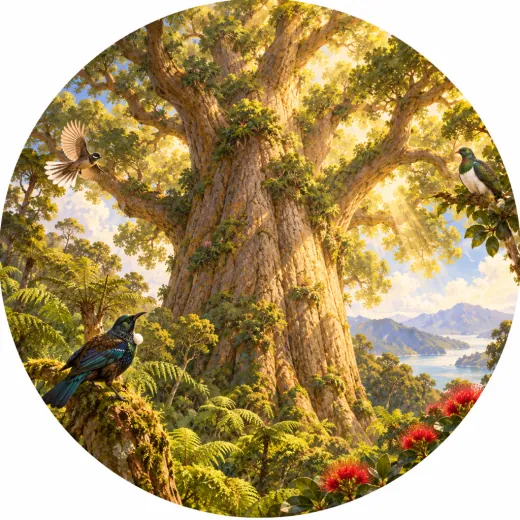
Tāne
Tāne Mahuta, in Māori
not scary at all
In the Māori tradition Tāne is the deity of forests and birds, the son who separated the sky from the earth. After bringing in the light, he clothed his mother Papatūānuku in trees and plants, and filled the woods with birds. It is also told that he shaped the first woman, Hine-ahu-one, out of earth, and gave her life with his breath. In another account Tāne climbed to the highest heaven and brought back three baskets of knowledge, with all the wisdom useful to people. Trees and birds are seen as his children.
Did you know? New Zealand's largest kauri tree, about 50 metres tall, is called Tāne Mahuta: it is thought to be more than a thousand years old, perhaps much older.
The story
In the beginning there was darkness, and in the darkness an embrace.
Ranginui, the Sky, and Papatūānuku, the Earth, held each other so tightly that not even a crack of space was left between them. There was no light, no wind, no room to breathe. And in between, squashed flat, lived their children.
There were many of them, and each had a character of his own. There was Tū, who loved battle. There was Tāwhirimātea, who brought the winds. There was Tangaroa, who would become lord of the sea. There were Rongo and Haumia, and there was Tāne, the most patient of them all, who would one day be lord of the forests.
But the children had none of that yet. They had only the dark, the struggle, and a question that grew louder every day: you can't live like this. What do we do?
One evening they gathered in a corner and spoke in whispers, so their parents would not hear.
“Let's kill them,” said Tū, his voice hard. “If they're dead, we'll have room.”
No one answered. Tāne shook his head.
“No. They are our father and our mother. We will not hurt them. Let's separate them. Let the Sky rise and the Earth stay where she is. Then we will have light, and they will stay alive, gazing at each other from afar.”
Tāwhirimātea leapt to his feet. “Don't touch my father,” he shouted. “What you do will mean war.” And he stormed off, and already a distant rumble could be heard.
The others tried, one after another. Rongo tried, and failed. Haumia tried, and failed. Tangaroa tried. Not even Tū, with all his strength, could shift their parents' embrace by a finger's width.
In the end only Tāne was left.
He knelt, then lay down with his back against Papa, his mother, and planted his feet against Rangi, his father. For a moment he stayed still, breathing.
Then he pushed.
It was not a sudden heave. It was a long effort that drained his body and his mind. His legs trembled, his back groaned. Beneath him he could feel the earth moaning, and above him the sky resisting. Rangi and Papa cried out, but softly, the way you cry out when it hurts but you don't want to frighten anyone.
“Why have you done this to us?” asked Papa. “Why are you parting us?”
“Because your children must live,” Tāne answered through clenched teeth. “Forgive me.”
And suddenly, between his parents' bodies, a thin gap opened.
It was light.
A faint light, grey and cold, that no one had ever seen. Then wider, then white, then golden. The children covered their eyes, dazzled. Rangi rose, slowly, higher and higher, and Papa stayed below, stretched out beneath the widening sky. Tāne kept pushing until the sky was far enough away to leave a space where trees could grow.
Ever since, Rangi and Papa have still been reaching for each other. They say the Sky's tears are the rain that falls on the Earth, and the Earth's sighs are the mist that rises from the forests in the morning.
When the world had light, Tāne looked around and saw that his mother was bare and silent, and looked sad.
“You are not as beautiful as you should be,” he told her. “I will clothe you.”
So Tāne began to plant. He put trees on the hills and in the valleys, ferns on the forest floor, moss on the stones and vines among the branches. He made the trees grow very tall and straight, and their leaves opened towards the sky. Papa seemed to smile. Every time the wind passed, the whole forest rustled like a voice.
It was not all peace. Tāwhirimātea, the brother who had not wanted the separation, did not forget. He came with the winds, with black clouds and thunderstorms, and hurled himself at the forest. Trees bent, branches snapped, leaves flew away in whirlwinds. Tāne stood in the middle of the forest without fighting back, and watched his trees bow down and rise again, one after another. When the storm had passed, the forest was wounded but alive.
But the forest, as it was, was silent, and Tāne thought about it for a long time.
He called the birds. They came in flocks, in the strangest colours: green, blue, red. Some sang, some whistled, others tapped their beaks on the trunks. The silence filled with sound. Tāne listened, and said: “There. Now the forest speaks.”
From that day on, the trees and the birds were called his children.
Then Tāne thought about the people who would live in that world. He took some more earth, shaped the figure of a woman, gave her his breath, and she woke. He called her Hine-ahu-one, the girl made of earth.
But one last thing still seemed to be missing: knowledge. Without it, people and birds would be beautiful, and blind.
Tāne decided to climb.
The sky had many levels, one above the other, and he climbed from one to the next, the way you climb a ladder. The higher he went, the thinner and quieter the air became. Stars and winds streamed past on either side. In the last heaven, the highest of all, were those who kept the most ancient things, and Tāne bowed.
He asked, and he was given three baskets. Three woven baskets, full of all the knowledge people would need. He carried them down clasped to his chest, without opening them, and on the way down he never looked below, so as not to lose his balance.
When he arrived, he set the baskets down on the earth and said only: “Here.”
People would have enough to learn for generations.
Today, in New Zealand, there is a tree that bears his name. It is an enormous kauri, about fifty metres tall, and it is called Tāne Mahuta. It is thought to be more than a thousand years old, perhaps much more. Its trunk is so wide that it takes many people to hug it.
Standing before a tree like that, you feel like keeping quiet, as you would before someone far older than you.
And high up, among the branches, a bird takes up its song again.
A living tradition, told with respect: how we tell myths.
Relatives around the world
Listen / Read next
- Music to read by: Cinematic JourneyEpic film-style music, no lyrics, by Ciro Simone IrmiciSpotifyYouTube Music
Sources
- Te Ara, the Encyclopedia of New Zealand, Te Waonui a Tāne – forest mythology
- George Grey, Polynesian Mythology (1855)
