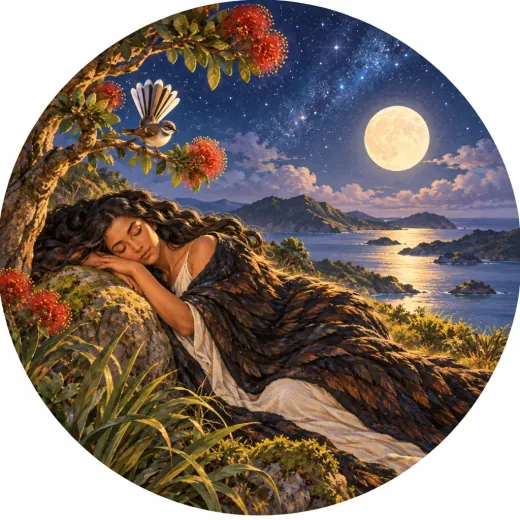
Hine-nui-te-pō
“the great woman of the night”, in Māori
scary
In the Māori tradition Hine-nui-te-pō is the great lady of the night, who welcomes the dead into the world below. Once she was called Hine-tītama, the maiden of the dawn; then she went down beneath the earth and changed her name, to look after her children after life. The best-known story is Māui's last adventure, when he wanted to defeat death for everyone: while she slept, he tried to pass through her. But a little bird, the pīwakawaka, burst out laughing and woke her. It was the end of Māui, and since then all people are mortal.
Did you know? The pīwakawaka, a little bird with a fan-shaped tail, is often seen in New Zealand: for some Māori families it is a messenger between the living and the dead.
The story
Night is older than you might think.
Before Tāne brought the light, before the world had a sky, there was only darkness, and out of the darkness everything was born. That is why, in the Māori tradition, night is not an enemy. It is the mother of all that exists. And the lady of the deepest night, the night where the dead go, has a long and great name: Hine-nui-te-pō.
But she was not always called that.
Once she was a girl. Her name was Hine-tītama, the maiden of the dawn, and when she walked in the forest the leaves seemed to lift to look at her. She smiled often. She sang as she worked. She was the daughter of Tāne, lord of the forests, and no one in the world had a clearer gaze than hers.
One day, though, Hine-tītama learned who the man she lived with really was, and the world turned upside down before her eyes.
She did not scream. She sat down and stayed still for hours, her hands on her knees. Then she stood up, without a word, and left the house. She walked towards the end of the world, where the road goes down and the sky hangs lower.
Tāne followed her. He called her name, again and again. She did not turn round. She came to a black threshold, where the world below began, and there she stopped.
“Don't come,” she said. “Not here.”
“Will you come back?”
Hine-tītama shook her head. “This road is mine. You go back to where the light is. Raise our children, give them food and a roof. I will stay here, and when their time comes I will draw them down to me and welcome them.”
She went down. The light of the dawn that she carried with her faded little by little, like a lamp moving away down a corridor. When the darkness had taken all of her, she had another name. She was no longer the maiden of the dawn. She was the Great Lady of the Night, and from that day on all the dead would cross the same threshold.
Many generations went by. On earth there lived a bold, restless man, full of ideas: Māui. He had slowed the sun so the days would be longer. He had pulled whole lands up from the sea with a fish-hook. He had brought fire to people. There was no feat that frightened him.
Only one thing remained that he had not beaten: death.
“What if I tried?” he said to his father one day. “What if I could beat her too, for everyone?”
His father looked at him sadly. “Do you know the great lady of the night? She lives down at the bottom of the world. Her eyes are of greenstone, her hair is like seaweed, and her teeth are of obsidian. They say she will be your end.”
“Then I'll go and visit her,” said Māui, and smiled.
He set off towards the edge of the horizon, with a group of little birds flying alongside him. There was the pīwakawaka, with its fan-shaped tail, which never keeps still, and others, smaller still, hopping from branch to branch.
The journey was long. They passed through forests that grew thinner and thinner, then plains without a single tree, then a stretch of grey sand where even the shadows seemed fainter. Māui did not talk. For the first time in his life he walked without boasting of a great deed. Now and then, behind him, one of the little birds would stop and look back towards the light, which was growing small.
They reached the edge of the dark. The air changed. It turned cold, still, silent. The branches no longer rustled. The little birds huddled together on the low branches.
“Listen to me carefully,” Māui whispered. “She is asleep. I will go in on one side and come out on the other, and when I come out, death will be over. But you must not make a sound. Don't laugh, don't sing, don't breathe a word. Wait until I am out again.”
The little birds nodded. The pīwakawaka already wanted to laugh, but held it in.
Māui took off his cloak and stood still for a moment, looking at her.
Hine-nui-te-pō lay asleep in the dark, enormous and peaceful, and her breathing made a slow sound, like the distant sea. She did not look wicked. She only looked tired.
Māui took a deep breath and went closer. He made himself small, smaller than he had ever been, and began to go in.
In there, time did not pass. The little birds held their breath. The darkness seemed to be listening. All that could be heard, now and then, was the slow breathing of the lady of the night, and the faint rustle of someone moving forward.
Half his body was already inside. Then more.
He was nearly there. So nearly.
It was the pīwakawaka. Perhaps the tension was too much. Perhaps the scene, seen from outside, was just so strange, a man squeezing into the goddess of the night, that it could not hold back. A laugh escaped it. A tiny, shrill one, with that cheerful trill of its own.
In that total silence, it was like a thunderbolt.
Hine-nui-te-pō opened her eyes.
There was no anger in her gaze. There was not even surprise. There was only a great weariness, the weariness of someone who had always known how it would end, and Māui never came out again.
And so, they say, the man who had beaten the sun, the sea and fire was beaten himself. And from that day on, all people are mortal.
Yet for the Māori, death is not a monster that devours. Hine-nui-te-pō hates no one. Whoever comes to her finds a place, finds an open door and a voice that has waited a long time. She waits for her children, one at a time, as she promised.
And the pīwakawaka? It still lives in New Zealand, and you can see it everywhere. In forests, in gardens, along the edges of paths; sometimes it even comes into houses. It flits around people as they walk, its tail spread wide, chirping all the time.
It is said to carry messages between the living and the dead. For some Māori families, if one comes into the house, it has come to tell them something.
But it is only a little bird. It laughs at nothing, and it doesn't even know why.
A living tradition, told with respect: how we tell myths.
Relatives around the world
Listen / Read next
- Music to read by: Cinematic JourneyEpic film-style music, no lyrics, by Ciro Simone IrmiciSpotifyYouTube Music
Sources
- George Grey, Polynesian Mythology (1855)
- Te Ara, the Encyclopedia of New Zealand, Māori creation traditions
