Taniwha
taniwha, in Māori
a little scary
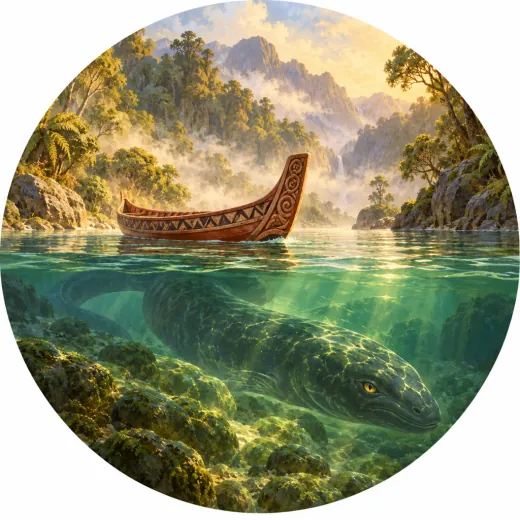
In the Māori tradition of New Zealand, taniwha are powerful beings who live in rivers, lakes, caves and stretches of sea. They can take the form of a large reptile, a shark, a whale or even a floating log. For many communities they are protective guardians who warn of danger and defend their own people; for strangers or for those who show disrespect, however, they can be dangerous. Many tribes have their own taniwha, linked to a particular place.
Did you know? In New Zealand the route of new roads has sometimes been debated or changed partly out of respect for the home of a taniwha.
The story
In New Zealand, which the Māori call Aotearoa, every river has a name, and sometimes it also has someone living in it.
What follows is a story we imagined: real taniwha each belong to a tribe, which looks after their stories.
That morning the girl had gone down to the water with her grandmother, as she did every morning. The river made a wide, slow bend, with a dark cliff on the far bank and tall reeds bending in the wind. Her grandmother filled the baskets. The girl watched the water.
She was the one who noticed the log.
It was floating in the middle of the river, big and black, as long as a canoe. It wasn't the first time a log had come down from the mountains after rain. But this one wasn't coming down.
The river was flowing towards the sea, and the log was going against the river.
The girl watched it move upstream, unhurried, without a sound, without so much as a twig shifting. She felt a faint chill on the back of her neck.
“Grandma,” she said quietly.
Her grandmother looked up. In her village they called her kuia, which means elder, the one who knows. She looked at the log for a long time, then put down her basket.
“That isn't a log,” she said.
She said nothing more. She took the girl by the hand and climbed the path back to the village without turning round. But the girl turned round. She saw the log stop right under the cliff, and for a moment, just one moment, she saw something long and smooth rise out of the water, like the back of a huge animal, and then dive straight back under.
From that day on, the village spoke in whispers.
Everyone knew who lived in the river. They didn't say it out loud, because some things are not spoken without a reason. But children learned early that the water had a guardian: that you didn't throw stones into the pool under the cliff, that you didn't take more fish than you needed, that before crossing you said a short prayer, a karakia, to greet the one below. The taniwha, the grown-ups explained, is not a monster and not an animal. It is the guardian of the river, and the river, in turn, was the guardian of the village.
Many moons went by.
One evening the sky turned a nasty grey, and a low rumble began to come down from the mountains. The girl, a few hands taller by now, came out of the house to fill a gourd with water and stopped on the bank.
The river was too calm.
There wasn't a ripple, not a single leaf turning. It looked like a black mirror, and in the mirror, at the bend under the cliff, the log had come back. It wasn't moving. But it had turned sideways, and its end was pointing upriver, like a finger.
Before she even understood why, the girl was running.
“Grandma! Grandma, it's back! Look which way it's turned!”
The kuia came out, looked at the river, looked at the sky, and asked no questions. She clapped her hands three times, hard. Doors opened one after another. A few words were enough: “To the high houses. Take the children, take the nets. Now.”
Nobody argued. In less than an hour the whole village had climbed the hill, and from the hill they watched the river change its face.
A flood came down, the kind that looks like a wall. It swept away the reeds, the stones, the old posts of the landing place. It covered the path where, that very morning, people had gone to fetch water. The water got into the lowest houses, stayed there a whole night and left at dawn, leaving only mud.
But the houses were empty. Nobody was hurt.
At dawn the girl went down to look. In the yellow, churning water, in the middle of the bend, a long black log was floating slowly towards the sea. This time it was going with the current. As it passed in front of her, for a moment, it stopped.
“Thank you,” said the girl. She never knew whether she had said it out loud.
That was the river everyone respected. But every river has its passers-by.
One season some travellers arrived from far away, people who didn't belong to that valley. They were tired and proud, and the old woman warned them kindly: “Someone keeps watch here. Greet the water before you touch it.”
They laughed. One of them threw a stone into the pool under the cliff, to see what would happen. Another filled his baskets with fish right up to the brim. The third said that stories about walking logs were village nonsense.
Towards evening they got into a boat to cross.
There wasn't a breath of wind on the river. And yet, halfway across, the boat began to turn. Slowly, then faster, as if caught in a whirlpool no one could see. The water around them went black. The three stopped laughing. Someone shouted. Someone, at last, remembered to say the prayer, but the voice was far too small.
Then, all at once, the boat stopped. The river was smooth again.
That night the travellers reached the bank soaked and silent. The next morning they left without the fish, without the stone, without a word, and they were never seen in that village again.
Many seasons passed, many years, many generations. The girl grew old in her turn, and it was she who told her grandchildren and great-grandchildren that there was a guardian in the river.
One day some men arrived with maps, rulers and big yellow machines. They had to build a road, long and straight, and the easiest place to run it was right through the bend under the cliff. The chief engineer spread his maps on the table and drew the line in pencil.
The old woman listened in silence. Then she said just one sentence: “Someone lives down there.”
The engineers looked at each other. One or two smiled. But the chief engineer didn't laugh: he looked at the cliff, he looked at the river, he looked at the woman, and he rubbed out the line.
Today, the road makes a small, wide curve. Nobody quite knows why. When you reach that spot by car, you slow down without noticing.
And under the cliff, in the dark water, something keeps watch.
A living tradition, told with respect: how we tell myths.
Relatives around the world
In the trails
Listen / Read next
- Music to read by: Cinematic JourneyEpic film-style music, no lyrics, by Ciro Simone IrmiciSpotifyYouTube Music
