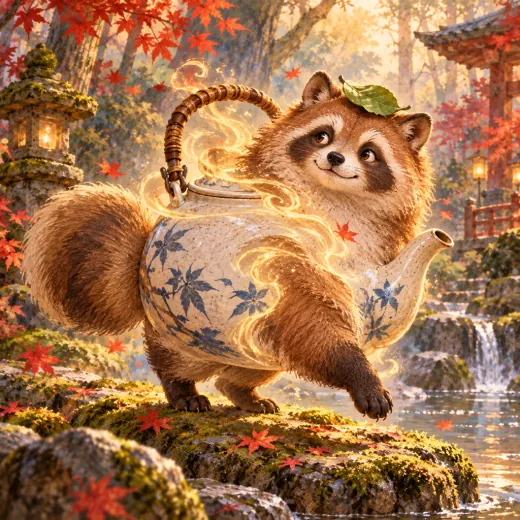
Tanuki
狸, the raccoon dog
not scary at all
The tanuki is a real animal, the raccoon dog, but in Japanese folklore it is a comical shape-shifter. It puts a leaf on its head and becomes a person, an object, even a teakettle. It loves fooling travellers, paying with leaves turned into coins and having a good time. A famous story tells of a tanuki that turned into a teakettle and was sold to a temple; when the monks put it on the fire, the kettle sprouted legs and a tail and ran off squealing.
Did you know? In front of many Japanese restaurants there is a tanuki statue with a straw hat and a big belly: it brings luck and good business.
The story
If one day, out in the countryside, you see a traveller go by with a leaf on his head, watch out. He is probably not a traveller.
He is a tanuki.
The tanuki, to tell the truth, is a real animal: a furry, round creature with a black mask around its eyes, which looks like a raccoon and roams the woods at night. But in Japan, tradition says, the tanuki does something real raccoons do not: it puts a leaf on its head, says a little word, and turns into whatever it likes. A monk, a merchant, a stone, a lantern. A tea kettle.
And it is a tea kettle that this story is about.
A long time ago, in a village among the rice fields, there lived a very poor man. He had a house with a leaky roof, a vegetable patch the size of a bedsheet, and nothing else. But he had a kind heart, and in fairy tales that is worth more than a treasure chest.
One morning, coming back from the woods with a bundle of firewood, he heard a whimper. Behind a bush was a hunter's trap, and in the trap was a tanuki with one paw stuck, crying with its nose between its paws and its tail all ruffled.
“Have mercy,” it said. “I'm just a poor tanuki. I swear I haven't done anything.”
“Are you the one who paid for his noodles with leaves?” asked the man, who had heard the rumours.
The tanuki pretended not to hear. Then, in a small voice: “Only once. I was very, very hungry.”
The man sighed. With the strength of his arms he prised the bars of the trap apart and let it out.
“Off you go, and don't get caught again.”
The tanuki limped to the edge of the woods. Then it turned round, gave a bow so low it almost touched the ground, and vanished into the bushes.
That night, while the man was asleep, someone knocked at the door. Softly, three times.
Outside stood the tanuki, with a pilgrim's hat perched crookedly on its head, or perhaps it was a leaf.
“I've brought you a present,” it said. “Actually, I am the present.”
“What do you mean?”
“Tomorrow I'll turn myself into a tea kettle. A beautiful iron tea kettle. You take me to town and sell me. They'll give you a nice pile of money.”
“But I don't want to sell you.”
“Don't worry, I can look after myself.” The tanuki patted him on the shoulder with its paw. “Besides, for you it's a bargain.”
The man never quite understood how, but the next morning there was a shiny, pot-bellied kettle on the table, with a lid and a handle, looking like a very pleased kettle indeed.
He took it to town. A monk from a temple saw it on display at the market, picked it up, turned it over, sniffed it, and said:
“Lovely. How much?”
The man named a price at random. The monk offered half, and they met in the middle. The man went home with a heavy purse and a whole sack of doubts.
Meanwhile, at the temple, the kettle was washed, scrubbed and polished. The monks gazed at it in admiration.
“Let's put it on the fire,” said the old monk. “We'll make some tea.”
They filled it with water. They set it on the brazier. They waited.
For a while the kettle stayed calm. Then, slowly, it began to sweat.
“Mm,” said the kettle.
The monks looked at each other.
The water began to bubble. The kettle turned red. From under its lid came a thin wail that sounded like a voice.
“Ow. Ow, ow. It's hot!”
“Did you hear that?”
“A talking kettle…”
“OW! HOT! BOILING HOT!”
All of a sudden, out of the rim of the kettle popped a furry head with a black snout, then four paws, then a bushy tail. The kettle jumped off the fire, rolled across the floor, tipped hot water over the nearest monk and shot off down the corridor, legs going every which way, its iron belly clanking, yelling:
“Help! They're cooking me! They're cooking me!”
The monks ran after it. The kettle swerved round a pillar, leapt over a cat, skidded on the polished floor, squeezed under a door and dashed across the garden. The old monk, his robe flapping, shouted: “Stop it! It's a demon!” Another, faster one missed it by a whisker and ended up in the fish pond.
But by then the tanuki was out of the gate.
It ran along the path, jumped the ditch, crossed the rice fields, and towards evening it knocked, panting, at the man's door. Its belly was swollen, its paws were singed, its tail was frayed, and it looked deeply offended.
“They nearly cooked me!”
The man did not know whether to laugh or cry. He treated its burns and gave it something to eat, and the tanuki, stretched out by the fire, thought out loud.
“I've had an idea,” it said. “If people will pay for a kettle, they'll pay even more to see one that walks.”
The next day a sign appeared in the market square: Bunbuku chagama, the kettle that puts on a show. A rope was stretched between two posts. The man, a fan in his hand, announced the act. And on the rope, perfectly balanced, with its lid on its head and a fan in one paw, appeared the kettle.
It walked forwards. It walked backwards. It spun round, waved with its tail, and at one point, just for effect, it even started to dance.
The crowd stood open-mouthed. Then they burst into applause so loud it could be heard in the next village.
The show went on for days, then for weeks. People came from everywhere. The man bought a new roof, then a house, then a field, and he was never poor again.
One day the tanuki said to him: “I'd say you're all set now. I'm off for a rest.”
“Stay,” said the man.
“I'll stay a while,” said the tanuki, “but no more fires.”
They say that ever since, tanuki have had a special respect for people who open traps. And even today, outside many Japanese restaurants, there is a statuette of a tanuki with a straw hat, a big belly and a rather cunning look. They say it brings good luck and good business.
But just to be safe, the restaurant owners always check the bill.
A living tradition, told with respect: how we tell myths.
Relatives around the world
Listen / Read next
- Music to read by: Cinematic JourneyEpic film-style music, no lyrics, by Ciro Simone IrmiciSpotifyYouTube Music
Sources
- Bunbuku Chagama, traditional folk tale
- Michael Dylan Foster, The Book of Yōkai (2015)
