Momotarō
桃太郎, “Peach Boy”
not scary at all
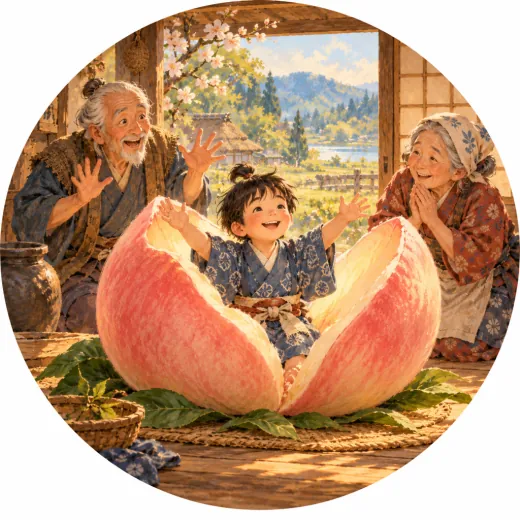
An old woman was washing clothes in the river when she saw a gigantic peach floating towards her on the current. She took it home and, when she and her husband tried to cut it open, they found a baby boy inside. They named him Momotarō, the peach boy. When he grew up, he set off to defeat the oni, the monsters who tormented people from a faraway island. Along the way he shared his millet dumplings with a dog, a monkey and a pheasant, who became his companions in adventure.
Did you know? Since the twentieth century the city of Okayama has considered Momotarō its hero, although the link is not an ancient one: in front of the station stands his statue with the dog, the monkey and the pheasant.
The story
Once upon a time there was an old woman who went down to the river to do her washing.
That morning the water ran clear, the air was mild, and the old woman scrubbed the sheets with her back a little bent, thinking old people's thoughts: that the rice was growing well, that her husband had a cough, that there had been only the two of them in the house for far too long. They had never had children.
Suddenly she heard a sound. She looked up.
Down the current, bobbing gently, came something pink and round, as big as a pumpkin. The old woman rubbed her eyes. It was a peach. A giant, glossy peach, with a sunset-red blush, that looked like fruit from a dream.
“Come here, come here,” said the old woman, and she pulled it to the bank with a stick. She did not even need to think: she heaved it onto her shoulders, though it weighed as much as a boulder, and carried it home, one step after another.
When her husband came back from the hills with his bundle of sticks, he found it in the middle of the kitchen, sitting on the table.
“And what's this?”
“I found it in the river. Let's eat it.”
The old man took a long, sharp knife and rested it on the skin. But before the blade could cut it, the peach split open by itself with a crack, and from its centre, springing out like a jack-in-the-box, came a little boy.
The old couple stood there with their mouths open.
“Here I am!” said the child. “I've come to keep you company.”
They called him Momotarō, the Peach Boy.
He grew quickly, and he grew strong, stronger than all the other boys in the village. At fifteen he lifted boulders for a bet and helped the neighbours move trees. But his kindness was even greater than his strength, and there was not a child who did not want him as a friend.
One day bad news reached the village. The oni had landed, from the island of Onigashima beyond the sea.
The oni are the demons of Japan: huge, with horns on their foreheads, red or blue skin, clothes of tiger skin and iron clubs. They came at night, stole the rice, stole the cows, carried off people's treasures. Nobody had the courage to stand up to them.
Momotarō listened. Then he went to the old couple.
“Grandfather, Grandmother, I want to go to Onigashima. I want to defeat the oni.”
The old woman went pale. The old man stopped chewing. But after a long silence, the old man put down his bowl and said: “If that is what you want, go. Come back safe.”
The old woman set to work without a word. She ground the millet, kneaded the dough, and made the best dumplings in Japan, kibi-dango. She wrapped them in a bundle and tied it to her son's belt. Then she gave him a banner that read “the first in Japan”, and a warrior's helmet.
“Come back soon,” she said. But her voice was trembling.
Momotarō set off. He walked for hours, through the rice fields and then through the woods, until all of a sudden a dog blocked his way.
“Woof! Where are you going, young man? And what have you got in that bundle?”
“I'm going to Onigashima, to defeat the oni. And I've got millet dumplings.”
“Give me one,” said the dog, “and I'll come with you.”
Momotarō smiled and handed him one, and the dog gobbled it down in a single bite. Then he fell in at his side.
Further on, up in a tree, a monkey was pulling faces. She wanted a dumpling too. She joined them too.
Then, in a field, along came a pheasant with green feathers and a blue breast. He cried: “Who are you? Where are you going?” He got his dumpling. He joined them as well.
And so the four of them, the boy, the dog, the monkey and the pheasant, reached the beach, found a boat and crossed the sea. The dog, who had never been in a boat before, complained the whole way that his tummy was upside down. To take his mind off it, the monkey told him jokes he did not understand. Momotarō held the banner upright and looked straight ahead, saying nothing. The wind pushed them on, the pheasant led the way, and after a whole day a black smudge appeared on the horizon.
Onigashima.
It was an island of dark rocks, with a great stone fortress and a closed iron gate. From inside came a din of tables and laughter: the oni were celebrating their loot.
“What now?” whispered the monkey.
Momotarō looked at his companions. The pheasant flew over the walls, fluttered above the roofs, spiralled down and began whirling round the hall, among the clubs, trying to make everyone lose their heads. The monkey, quick as a shadow, climbed up, went over the top and lifted the bar of the gate. The dog, barking, nipped the calves of any oni who turned round.
The gate flew open.
Momotarō walked in, banner in hand.
“I am Momotarō! I have come to stop you!”
The oni burst out laughing. Then they stopped. Because that boy, all on his own, knocked down the first with a shove, and the second with a shoulder charge, and the third sat down with a bump, and then one by one they all ended up on the floor, dazed, in a jumble of furs and cooking pots.
At last the chief of the oni, as big as a house, knelt down and pressed his forehead to the floor.
“Enough, enough! We surrender! Take whatever you want, but spare us!”
“You must give back everything you have stolen,” said Momotarō. “And you must never do harm again.”
“We swear.”
And so the oni brought out all their treasures. Gold, silver, pearls, jewels. Momotarō loaded them onto a cart, and the dog and the monkey and the pheasant pulled it all the way to the boat.
They got back to the village when it was almost evening. The old couple were waiting on the doorstep with a lamp lit.
“I'm home,” said Momotarō.
The old woman hugged him so hard that she dented his helmet.
That evening they all ate together: the old couple, the boy, the dog, the monkey and the pheasant. And nobody, they say, could stop smiling until dawn.
A living tradition, told with respect: how we tell myths.
Relatives around the world
Listen / Read next
- Music to read by: Cinematic JourneyEpic film-style music, no lyrics, by Ciro Simone IrmiciSpotifyYouTube Music
Sources
- Yei Theodora Ozaki, Japanese Fairy Book (1903)
- traditional Japanese fairy tale (Edo period)
