The Cowherd and the Weaver Girl
牛郎織女, “Niulang and Zhinü”
not scary at all
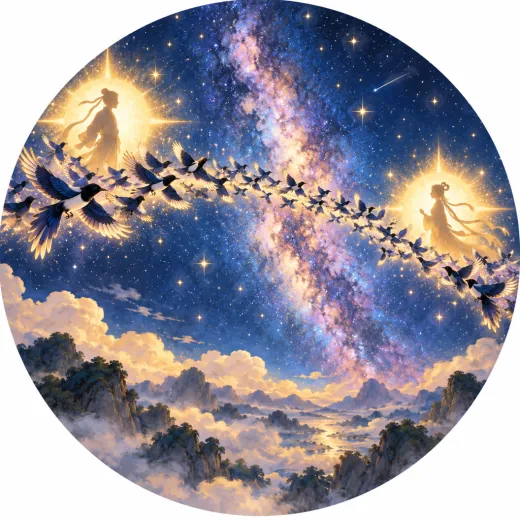
Zhinü, the Weaver Girl, was a maiden of the sky who wove the coloured clouds. One day she came down to earth and met Niulang, a poor cowherd: they fell in love, married and had two children. But the mother goddess of heaven took her back up and, with a golden hairpin, drew a river of stars between them: the Milky Way. Their sorrow moved all the magpies in the world, who once a year fly up and form a bridge with their wings, so that the two can meet.
Did you know? The two lovers are two real stars, Vega and Altair; their festival, Qixi, is celebrated on the seventh day of the seventh lunar month.
The story
High up, where the sky ends and the silver road begins, there lived a girl who wove the clouds.
Her name was Zhinü, the Weaver Girl, and she was a daughter of heaven. Every day she sat at her loom and sent the shuttle back and forth. From her hands came the lightest of fabrics: pink at dawn, golden at noon, red at sunset, every colour the sky shows to those who look at it. It was beautiful work, and it never stopped. Click-clack, click-clack. Without end.
Sometimes Zhinü paused for a moment and looked down. Below her lay the earth, with its thin rivers and its tiny houses. And to her, who had done nothing in her whole life but weave, the earth looked like a place where things happened.
One day, while the loom was resting, she went down.
She landed on the shore of a lake, among the reeds. The water was clear and the day was hot. With her sisters, who had followed her, she dived in, and for the first time in her life she swam without watching the time.
She did not know that someone was watching her.
Niulang was a cowherd, poor, orphaned as a boy. He had nothing but an old ox that he worked the land with. The ox loved him, and one morning, in a low voice, it spoke.
“Niulang,” it said, “today, at the lake, there are maidens who have come down from the sky. If you take the clothes of one of them, she won't be able to go back up, and she will stay with you.”
Niulang blushed. It did not seem right to him. But it also seemed to him that if he didn't do it, he would lose something that would never come back. He went to the lake. He took a pink robe hanging from a branch. The sisters heard a twig snap and flew back up in fright. Only one stayed behind, hidden among the reeds, her arms across her chest.
They looked at each other. She was not angry. For a long time she said nothing. Then she said, “What's your name?”
They married without inviting anyone, because there was no one to invite. Niulang built her a hut, and she sewed him a suit of clothes. She worked at the loom by the window, and he drove the ox in the fields. It was a simple life, full of small things: the rice growing, the evenings on the doorstep, Zhinü's laugh. They had two children, a boy and a girl, who ran about the fields and played with the ox.
But up in the sky, someone had been counting the days.
Up there, Zhinü's loom had stood still. The clouds had lost their colours. Without its pink and gold, the sky had turned as grey as a tablecloth washed too many times. And so the Queen Mother of Heaven, mother goddess of all the heavenly maidens, realised where her daughter had gone, and came down to look for her.
That day Niulang was out in the fields. He came home to find the door open, the loom still, and the children crying on the doorstep.
“Where's Mummy?”
There was a rustle above his head. He looked up.
High in the clear sky, he saw Zhinü being carried upwards on a cloud, her hands reaching out towards him. Beside her, stern and still, stood the mother goddess.
Niulang did not stop to think. He took two baskets, put the children in them, tied them to a pole and ran. The old ox had died the winter before, and before dying it had told him, “When you need it, use my hide.” He put it on. He felt it lift him off the ground, light as a leaf, and he began to rise.
Up and up he went. Zhinü saw him coming closer, and she wept.
When the Queen Mother saw him coming, she took a golden hairpin from her hair. With one movement she drew it through the air in front of her, and wherever the point passed, a furrow opened. The furrow filled with water. In an instant there was a river, wide, deep and glittering, with millions of stars floating on its surface. Niulang and Zhinü found themselves on opposite banks. They could see each other. They could call to each other. They could not touch.
That river is the Milky Way.
Niulang, on the bank, held the children in his arms and gazed at his wife on the other side. She sat down at the loom and began to weave again, because there was nothing else to do. But it was work without joy. Every now and then a tear fell on the cloth. Some tears fell all the way down to the earth, and on earth they became a fine rain.
It went on like that for a long time. Then the birds noticed.
The magpies were the first. They were kind-hearted birds that flew over the fields every day and knew the two lovers well. One day they decided to do something. They gathered in their thousands, from every corner of the world, black and white, and rose all together in a flock as thick as a cloud. They reached the river of stars. They settled side by side, wing against wing, beak against tail, until they had made a bridge.
The Queen Mother looked at that bridge of feathers for a long time. Her heart was hard, but it was not made of stone. She said, “Once a year.”
On the seventh day of the seventh month, every year, the two stars can be seen from the earth shining more brightly. They are Vega and Altair. On that night the magpies leave the fields, and for a whole day, they say, not a single magpie can be seen. People say that if you look at them closely the next day, you will notice that the feathers on their heads are a little worn, because all night long the weight of two people in love has walked across them.
Niulang crosses the bridge with the children. Zhinü leaves her loom and runs. For a whole night they hold each other. There is no need for words: they have the whole year to repeat them.
If it rains on that night, the old people say, those are not tears of sorrow. They are the tears of someone who is happy and does not know how to say so.
And at dawn, when the magpies must take flight again, the two of them part once more, without crying too much. Because they have known since the first time that every year, on the seventh day of the seventh month, the bridge will be there.
Relatives around the world
Listen / Read next
- Music to read by: Cinematic JourneyEpic film-style music, no lyrics, by Ciro Simone IrmiciSpotifyYouTube Music
Sources
- Shijing, Classic of Poetry (first mentions of the two stars)
- Anne Birrell, Chinese Mythology: An Introduction (1993)
