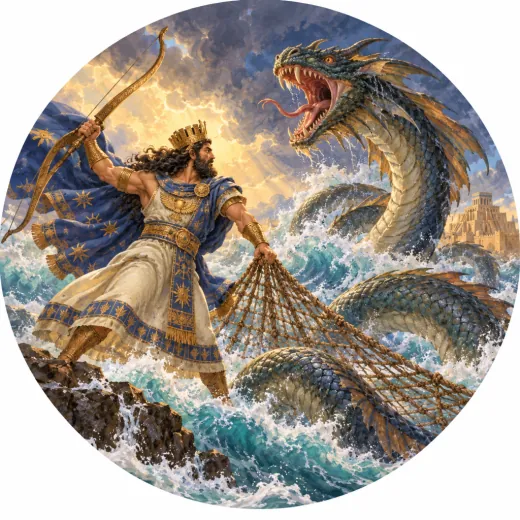
Marduk and Tiamat
from the poem Enuma Elish
scary
The Babylonian poem of creation opens with two waters mingled together: Apsu, the fresh water, and Tiamat, the salt water of the sea. The gods were born from them, but they were so noisy that a war broke out. Tiamat created an army of monsters and none of the gods dared to face her, except young Marduk, who asked to become their king in return. With a net and the winds he defeated Tiamat, and from her body he built the world: with one half he made the vault of the sky, and from the rest of her body came mountains, rivers and the rest of the world.
Did you know? The poem Enuma Elish is named after its first words, which mean “When on high”: according to later ritual texts, it was recited in Babylon at the New Year festival.
The story
In the beginning there was nothing. Only water.
There was no sky, no earth, no names. There were two waters mingling in the dark: Apsu, the fresh water, and Tiamat, the salt water, the deep black sea. From them, little by little, the gods were born.
They were young, and full of life. They ran about, played, quarrelled, slammed doors and made a din that cut right through the silence of the water. For Apsu, who was old and only wanted to sleep, that noise had become unbearable.
“I can't rest by day or by night,” he said to Tiamat. “I want to destroy them. Then I'll be able to sleep.”
Tiamat was outraged. “Destroy our children? And what for? A bit of racket? They've behaved badly, it's true, but we can be patient.”
But Mummu, Apsu's adviser, egged him on. “Do it. It will give you peace.”
The gods found out, and a frightened silence fell over them. The cleverest of them, Ea, wasted no time. He spoke a spell, soft as the whisper of water on sand, and Apsu fell asleep, a sleep from which he never woke. On top of his body, Ea built his house.
In that house his son was born: Marduk.
He was unlike anyone else. He had four eyes and four ears, and when he moved his lips, fire came out of his mouth. He was tall and strong and shining, and the gods looked at him with awe. His grandfather Anu gave him four winds to play with, and Marduk flung them across the waves, stirring them up and spinning them into whirlpools.
But that game woke someone who should have been left asleep.
Tiamat, still sleeping in the depths, felt herself shaken. The other gods, who had never forgiven Apsu's death, came close to her. “You lost your husband, and you do nothing. We can't rest: your sea throws us from one side to the other.”
Then Tiamat made up her mind.
She brought monsters into being. Serpents with venom instead of blood. A dragon with a tail as long as a ship. Scorpion-men, fish-men, bull-men, creatures no one had ever seen. She loaded them with lightning and terror, and called them gods. As their leader she chose Qingu, and hung the Tablet of Destinies round his neck, the tablet that said who ruled the world.
The army was ready. The sea was boiling, and the waves pounded against the darkness like fists.
The gods gathered in assembly. Ea went first to face Tiamat, but he came back with no words left. Anu tried too: but when he saw her, in her sea of serpents, he turned pale and went back. In the silence that followed, nobody dared to offer himself again.
Then Marduk stood up.
“I will go,” he said. “But on one condition. If I kill Tiamat and save you, my word will be law. My command will not be questioned.”
The gods hesitated. They were afraid, and he knew it. Then they agreed. They held a banquet and, to put him to the test, they made a garment appear in front of Marduk. “Make it disappear,” they said. Marduk spoke, and the garment vanished. “Now bring it back.” Marduk spoke, and it came back. His command was real.
Marduk made ready. He took up his bow, his mace, his lightning. He made himself a net and held it open by its four corners, so that nothing could escape. He called together the seven winds, and an evil, mighty wind, the fiercest of them all. He climbed into his chariot, drawn by four horses with poisoned teeth, and rode out to meet Tiamat.
The sea stood still.
For a long moment there was no sound at all. Only the noise of the water swelling. Marduk and Tiamat looked at each other across the distance, face to face, like two mountains.
“Who are you, to come rushing all the way here?” she roared.
“You have raised an army against your own children,” said Marduk. “You have given the command to one who does not deserve it. Come forward. Let us fight, you and I, alone.”
Tiamat shrieked like a fury and began to chant her spells, in a voice that made the waves tremble. Marduk did not answer. He cast his net.
Tiamat opened her jaws wide to swallow him, but the net wrapped round her, and at the same moment Marduk drove the evil wind into her throat. She could no longer close her jaws. The wind swelled her belly. Marduk took his bow and set an arrow to the string.
The arrow pierced her heart.
The sea fell silent.
Marduk tied up the monsters that were left, and those that a moment before had been roaring now huddled together like dogs in the rain. He tore the Tablet of Destinies from Qingu and hung it on his own chest. Then he went back to Tiamat's immense body, looked at it for a long time, and split it in two, the way you open a shell.
One half he lifted up and stretched out above him, and it became the sky. He fixed a bolt to it and set guards there, so that the waters could not come down. From her eyes he made the Tigris and the Euphrates flow, and from the rest of her body came the mountains and the world we know.
Then he stopped to think. The gods who had followed him were working without rest, and they were complaining. So he had someone made to work in their place: human beings, made from the blood of Qingu, the leader of the monsters.
To thank him, the gods built a city, and they called it Babylon. They gathered in the council hall and proclaimed him with fifty names, one for each thing Marduk could do: each name told of a power, and all of them together told who the king was.
In Babylon, according to some later texts, it seems that every year, at the New Year festival, the poem was read aloud in front of the statue of the god. It began with two words: Enuma elish, “when on high”.
When on high, above us, the sky did not yet have a name.
Everyone in Babylon knew that name. But every time the sea rose and the wind hurled it against the shore, someone would look up at the vault of the sky and think that this sky, once upon a time, had been someone.
Relatives around the world
Listen / Read next
- Music to read by: Cinematic JourneyEpic film-style music, no lyrics, by Ciro Simone IrmiciSpotifyYouTube Music
Sources
- Enuma Elish, the Babylonian poem of creation (2nd millennium BC)
